Buffer and its Founder/CEO Joel Gascoigne today referred disgruntled customers to their main competitor, Hootsuite. This post discusses this display of “lethal generosity.” For those who don't know, Buffer is a social media productivity tool allowing users to stock up or fill up a buffer of content to share that will then be disseminated over time on various social media platforms you connect to their service. This way, one's followers will not be overwhelmed by a number of updates at once followed by complete silence. I have personally found the service useful even if I have not consistently filled up my buffer as of late. Today, I was impressed by the service nonetheless. I got an email from the founder “Joel from Buffer” with an alert about a problem:
[Read more…]
BBC Interview on Personal Branding with a Website
In an interview with BBC Capital, I was asked about the value for professionals of developing a website where they can manage their personal brands to support their career objectives. To me, it is surprising that this is still even an issue almost twenty years after we started exploring the World Wide Web. However, as I often encounter confusion regarding both what owning your own domain implies and its value, I find it necessary to further (also wrote a related post on “Good Domain Parenting” earlier) articulate why I believe this is important and outline the first action steps. [Read more…]
Chapman Students Boost Swedish Startup’s Social Media

Recently, I published a blog post asking companies if they wanted student teams helping them with their social media efforts. Heeding the call was Swedish startup Oricane, a green technology company offering energy efficient software and big data solutions often reducing cost by 98% and power use by 99%.
“Give and Take” talk by Adam Grant

Glad I made it to Cal Tech where the Skeptics Society led by Michael Shermer hosted Adam Grant for a talk on his book “Give and Take.” In his presentation, Adam offered persuasive examples of how people who are indiscriminately helpful to basically anyone who asks can get ahead by accumulating a wider network over time and that what goes around comes around.
He claims that Mark Granovetter‘s theory of the strength of weak ties still holds true in that our strong ties often do not add significant news as they are exposed to the same sources and networks as we are ourselves whereas a weak tie moves in circles yet unfamiliar with us where new opportunities can emerge. [Read more…]
Staple Yourself to the Customer Experience

Today's wakeup call was provided by Brian Solis with his new blog post “The 5 Pillars of New Media Strategy.” Brian argues convincingly that we all should stop looking for a magic formula or success recipe to guide us in our social media travails by simply arguing that it all depends on who we are serving or building a meaningful relationship with. While I myself occasionally fall prey to the temptation to offer list type “secrets” such as in “3 Keys To Social Success,” I do agree that too much of the focus is placed on the social media delivery side. As a consequence, the tendency is to be less concerned about how our social media efforts will be received by customers. [Read more…]
Stick Shift Social Media
It is increasingly rare these days to encounter a car with a manual transmission and many young drivers barely know what it is, let alone are able to drive them. Some of the advantages of driving with a stick shift, such as the increased attentiveness and the sense of being one with the car, and are forgotten or ignored as the convenience factor of automatic transmissions wins more and more people over. There are those who still resist, though, those who swear by the superiority of manual stick shifting.
One twist to this dilemma was introduced last week when I met a parent here in Orange County who said that their kid's first car will get a manual transmission. Why? Well, then they would at least know that their kid would be so overwhelmed by getting the gear into the right gear, which means that they wouldn't be sending text messages! [Read more…]
Trust is Queen

“Content is King” is an oft-uttered “secret” to success in social media and while I don't think content will become unimportant any time soon, it is also becoming increasingly clear that just offering content, even good quality content, will not be enough any longer if it ever was.
“Context is King” is an alternative statement which has grown in popularity. The focus on context reflects the need for not just the right content to be provided but that it also needs to be made available to the right people, on the right platform, in the right conversation, at the right time, with the right tone, in the right quantity, etc. Sounds like logistics, right? [Read more…]
Your Personal Branding Objectives

When setting out to build or refine your own personal reputation and personal brand, your online presence can simply no longer be ignored. “Nobody is going to look or find that information on me online.” No? Are you kidding me? If you today would be about to hire somebody yourself, wouldn't you Google that individual's name at least once? And then dig deeper if something catches your attention? I bet you would.
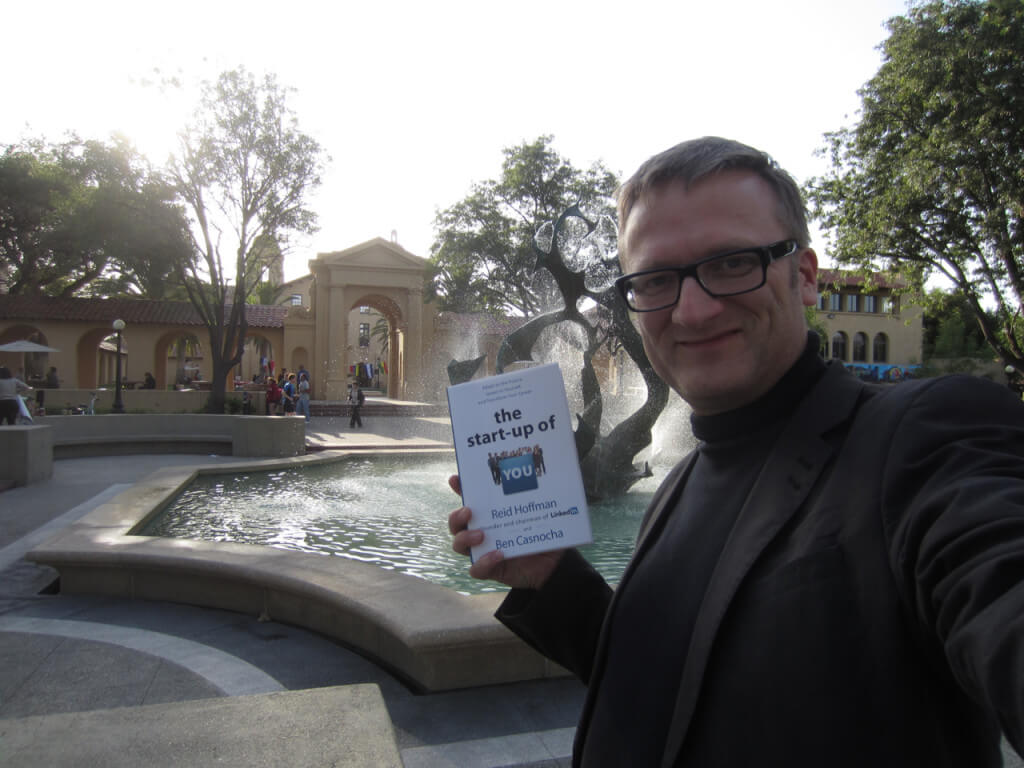
Still, your online first impression, however important that may be, is only the first gate you need to pass to go places. What is critical next is to have an entrepreneurial mindset about yourself and your whole career. In the book, The Start-up of You, LinkedIn founder Reid Hoffman and Ben Casnocha argues for a radical move away from the notion that you will be a lifer at a major corporation being promoted every few years. Instead, we are entering a more foreign and uncertain territory in which we have to adapt and reinvent ourselves and our personal brands continuously to stay with the times and to take advantage of the best opportunities for our skills. [Read more…]
Content on Demand
Tonight, we discussed the Harvard case study on Demand Media (of eHow.com fame) in my Social Media Marketing MBA class. It is a fascinating story about how content can be systematically produced on a vast scale and result in almost guaranteed demand from viewers and consequently also in profits for the advertisers.
The controversy regarding so-called “content farms” revolves around the opportunistic creation of content to meet current demands but doing so in a way that compromises content quality some claim. For example, Jeff Jarvis called Demand Media on this as he stated that they “create crap just good enough to fool the algorithm.” Google's search algorithm, that is. Clearly, Jeff Jarvis has a point in that somewhere, a line in the sand has to be drawn, and it is also clear that Demand Media is not striving toward writing dissertations on the topics they address.
The idea to develop and publish content that is likely to be searched has now been gaining traction for a number of years with bestselling books such as “Inbound Marketing” by the cofounders of HubSpot. What strikes me with this case, though, is the level of sophistication that seems to lie behind the proprietary algorithm used by companies such as Demand Media as they try to expedite the statistical analysis of search trends, paid ads, and statistics from social networks to get the order for the right content out there as soon as possible. See how Demand Media CEO Richard Rosenblatt defends his model:
Then, of course, someone has to produce the said content and the identification and recruitment of a vast stable of relevant content creators clearly represent another necessary strength needed in this space. It becomes clear that for one's own postings to be noticed for popular keywords, one has to be both fast and clever in terms of how posts are tagged and outlined 🙂
How Oreo Cookie ate from the Super Bowl
If any business still wonders whether they should be on Twitter, they should take note of the likely future Harvard Business School case study “How Oreo Cookie ate from the Super Bowl.” The key learning points:
Pay for the Ticket of Admission
You have to pay to play goes the saying and in this case, the ticket price is significant, $3,8 million for a 30 second commercial. Even if companies not placing Super Bowl ads also could get into the social media conversation during the game, it is more likely that you will be top of mind and followed by the socialverse if you have at least one entry in the ad mix. Oreo's entry was quite an engaging at that at least according to me and my 9-year-old daughter watching it. You judge for yourself:
http://youtu.be/6kMWLYYcAYw
Prepare the Decision Makers
It has now been quite established that companies need to prepare the IT infrastructure for spikes in traffic during the Super Bowl. Also, if you sell online, you may need customer service and order representatives on standby to ensure that everything runs smoothly. In this case, the preparedness was manifested in how the agency 360i set up a mission control room where they monitored the game. Key was also to include Oreo executives of sufficient seniority so that the team could get necessary approvals on the spot.
Expect the Unexpected
Finally, the mission of the team seems to have been to be on the lookout for noteworthy things during the broadcast and then quickly come up with engaging content related to it. Why is this effective? Well, as David Meerman Scott calls it in “Newsjacking,” you act fast to get included as part of a bigger story or the second paragraphs of newspapers covering the bigger story. Also, this blog post is just one of many others writing about this right now. So, what did this Oreo team come up with? Well, when the power went out during the game, Oreo went to work and after 15 minutes, the posted the following tweet.
Power out? No problem. twitter.com/Oreo/status/29…
— Oreo Cookie (@Oreo) February 4, 2013
- « Previous Page
- 1
- …
- 3
- 4
- 5
- 6
- 7
- 8
- Next Page »