
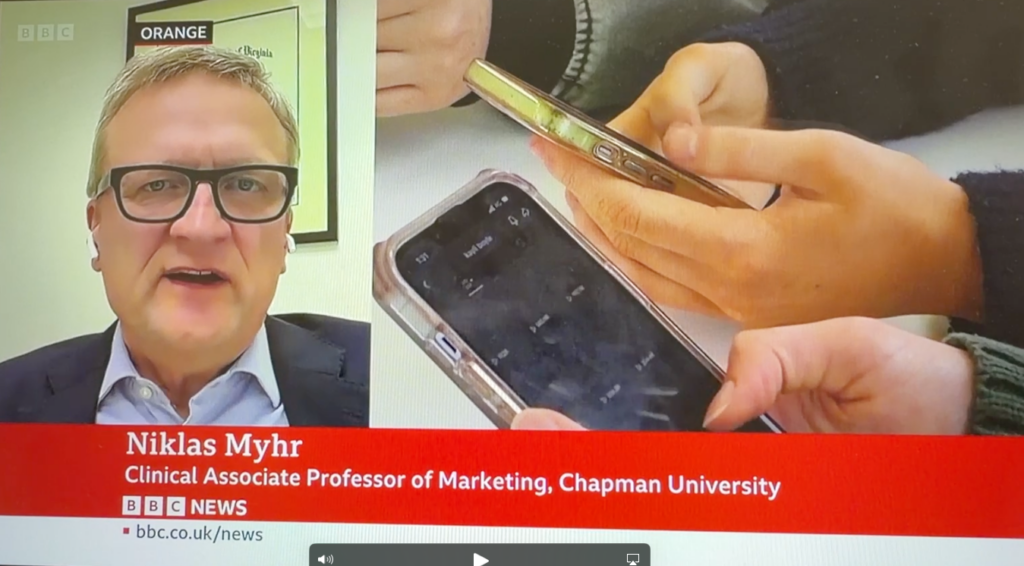
Australia’s teen social media ban gave me a chance to discuss, live on BBC News directly from my Chapman University office, why an all‑out prohibition on platforms for young people is unlikely to deliver the safety politicians are promising. In this post, I want to unpack the key points from that interview and explain why better enforcement, smarter design, and empowered parents beat blanket bans.
“I don’t think this is the right way to go about it”
When asked whether an all‑out ban could protect people online, my first reaction was clear: “I don’t think so… I don’t think this is the right way to go about it.” The intention may be “a laudable initiative in terms of doing something” about harms, but the execution raises serious problems.
One major issue is practicality: a nationwide age‑based ban “is going to be difficult to enforce,” especially when tech‑savvy teens are already accustomed to circumventing weaker age checks. If the rules only work on paper while young people quietly route around them, the policy risks becoming a symbolic gesture rather than a meaningful protection.
From regulated platforms to “worse places”
Another concern I raised is that some young people “may end up in worse places than highly regulated, potentially highly regulated tech platforms.” Mainstream social networks are far from perfect, but they at least have some degree of moderation, reporting tools, and public scrutiny.
If those options are shut down, the unintended consequence could be a migration to “different fringe websites that become new destinations for teens.” In other words, by closing the front door of big platforms, we may be nudging vulnerable users into back alleys of the internet where predators, extremist content, and zero oversight are more common.
Content moderation as a “balancing act”
In the interview, we also talked about how Europe, the United States, and now Australia are taking different paths on regulation and free speech. I emphasized that “content moderation has always been a balancing act.”
Platforms “have a responsibility to do some reasonable effort” to go after “bad content, systematic violators, [and] predators, and actually take them off the platform.” Europe is increasingly saying tech companies are “not doing enough, not nearly enough,” while the US remains less strict for now, in part due to free‑speech concerns. Australia’s move adds yet another model to this global tug‑of‑war over how far governments should go in dictating what happens on social platforms.
Why “teen accounts” and parental controls are not enough
The BBC host asked about Instagram’s heavily promoted “teen account,” with built‑in controls meant to keep younger users safer. My view is that this type of solution “probably requires parental control and supervision in order for it to work with today’s verification standards.”
Many teens will still “find ways to get access to the adult version anyway,” which limits the impact of these features. For platforms, however, such tools are convenient proof to regulators that “at least we’re doing something,” even if “that I don’t think is nearly enough.” Without robust age verification, better design defaults, and real collaboration with parents and educators, teen modes risk becoming more of a compliance checkbox than a real safeguard.
Social media as “the community center” and “the playground”
One part of the segment focused on angry young influencers in Australia who feel the ban is taking away both their social life and a potential income stream. When asked how important tools like TikTok are for today’s youth, I described social media as “the community center” and “the playground” for better or worse.
Even as “The Social Media Professor,” I said that I “clearly want people [teens] to go out and play and have fun and socialize” offline. Still, “not all online activity is bad, and not all screen time is a‑social”; many teens “have true relationships and communities” online. Removing them wholesale from these spaces ignores the reality that meaningful friendships, support networks, and creative collaborations now routinely start on screens.
Speech, politics, and building movements
Beyond friendship and fun, young people also “use this for speech and political lobbying and building movements and communities.” If bans like Australia’s become a template “in other countries as well,” youth may “have less ability to do” this type of civic engagement.
At a time when social and political debates are increasingly mediated by digital platforms, excluding under‑16s from the conversation carries consequences for how represented they feel in public life. The ban is not just a safety measure; it is also a restriction on how a generation participates in culture, activism, and democratic discourse.
Influencers, parasocial relationships, and making a living
The BBC piece also highlighted teen influencers whose ability to earn money is directly affected. I noted that “influencers is a real thing, whether you like it or not. Influencer marketing is here to stay.” For many young creators, social media is where they develop followings based on trust and parasocial relationships.
Some of these creators “are very young indeed,” building audiences and skills long before traditional employers would consider them. A hard cutoff at 16 does not just protect them from potential exploitation; it also shuts down early career experimentation, entrepreneurial learning, and legitimate income streams that families in some cases rely on.
Where this leaves regulators, parents, and platforms
Taken together, the arguments from the interview point toward a more nuanced path than an outright ban. Policymakers should focus on enforceable obligations for platforms to act against clear harms and repeat offenders, rather than pushing all under‑16s off mainstream services. Parents need better tools, transparency, and practical education, not just legal reassurances that teens are “not on social media anymore.”
For platforms, the message is that cosmetic changes will not suffice. They must take seriously their responsibility to design with youth in mind, to support healthier defaults, and to collaborate with regulators on standards that go beyond PR‑friendly “teen accounts.” Social media can be both dangerous and deeply valuable; treating it as today’s “community center” and “playground” is a better starting point than pretending we can simply lock the gates and throw away the key.

I’m glad I had the chance to read this article. I saw the news and initially thought the ban was a good idea. Upon further reflection, and after reading your post, it’s clear there are better solutions than a total ban. Frankly, Australia should have reached out to you for input before enacting the new law.
Thanks for your thoughtful comment, Mitch, and I always appreciate your input and I think Australia would do very well if they were to call you, or perhaps we should go there and offer our services together!