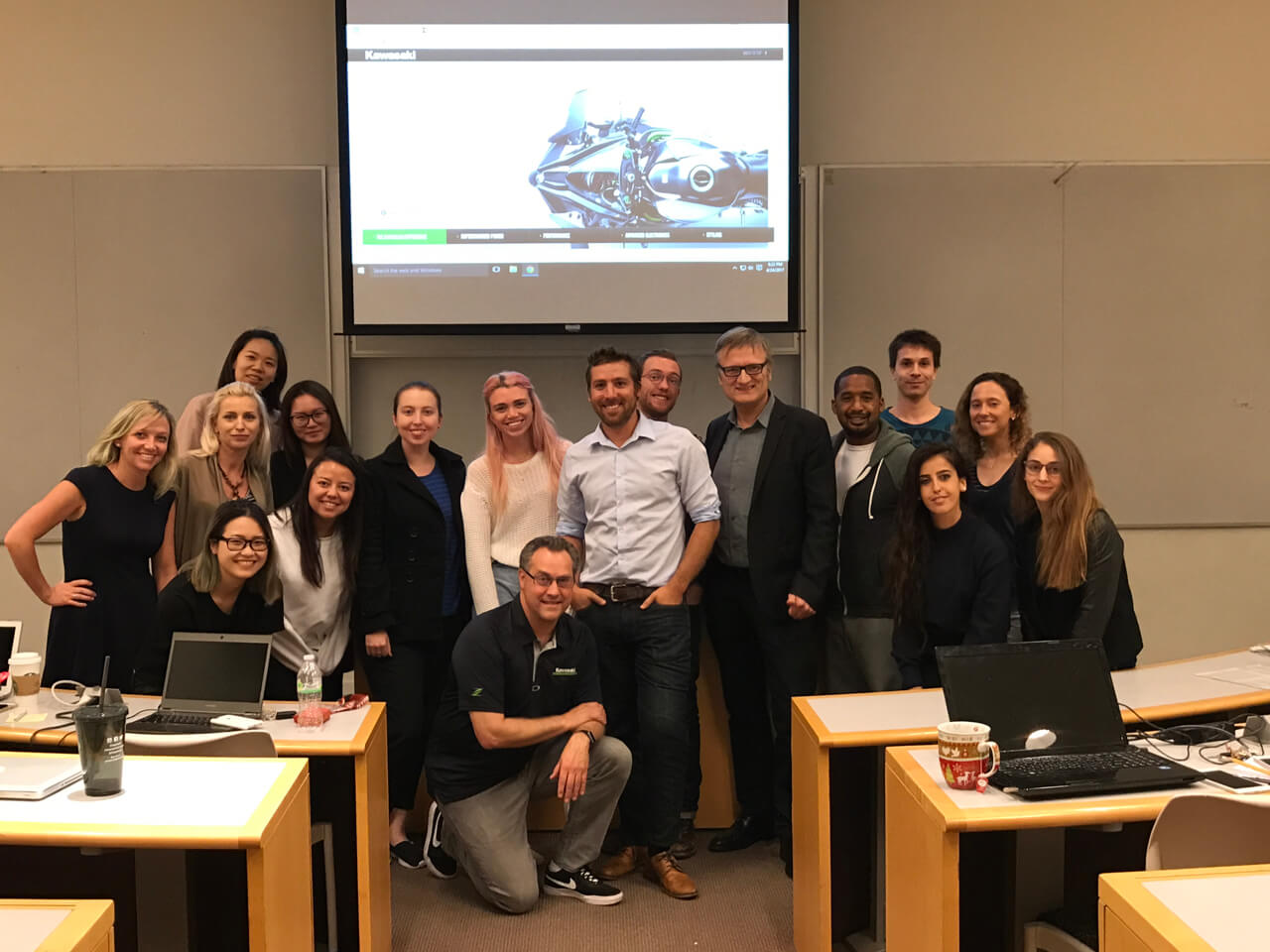
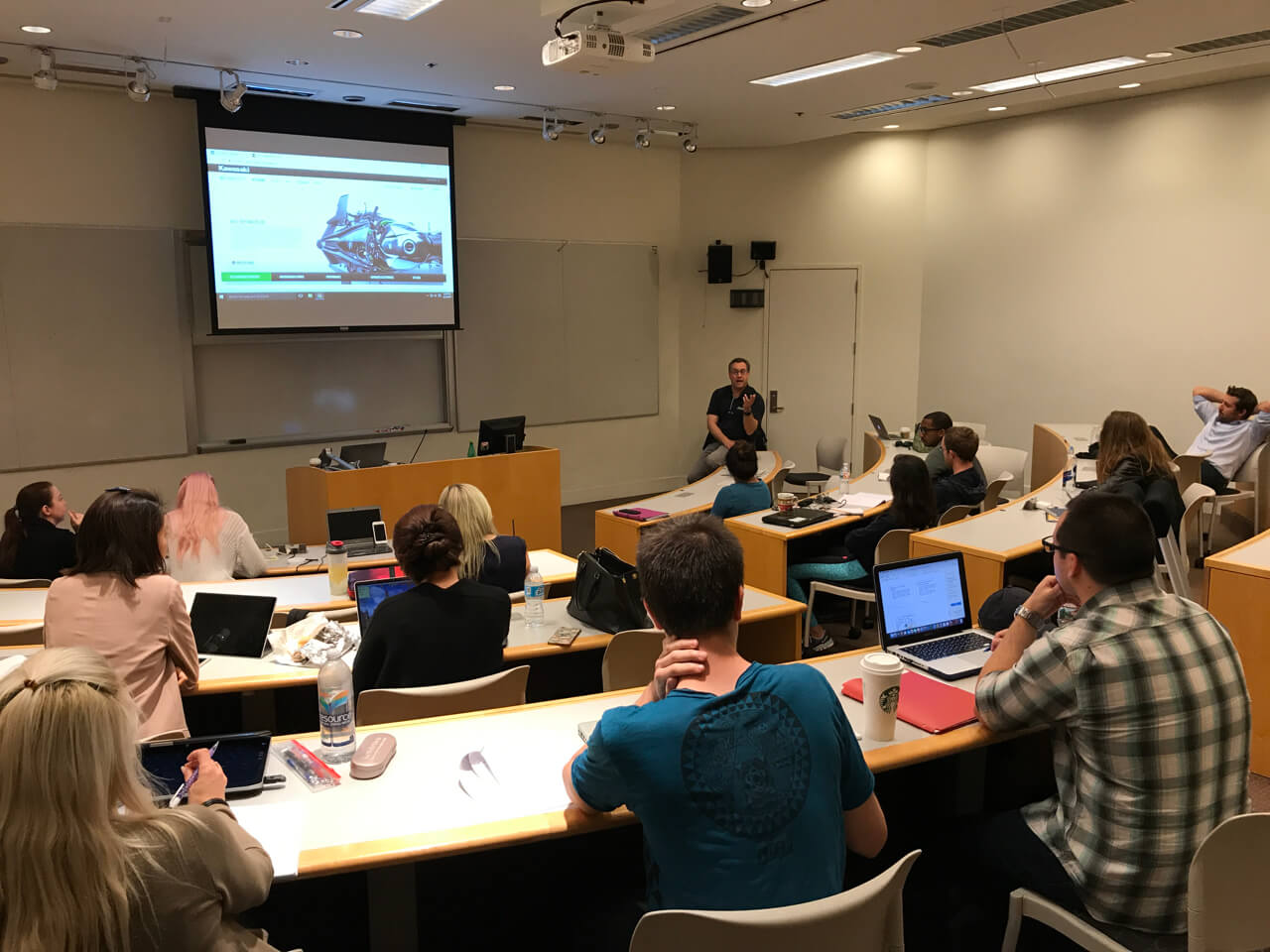
Chris Brull, Kawasaki Motors (kneeling), and Scott Shaffstall (center) at Chapman University International Marketing MBA class (pic by Andres Vaca)
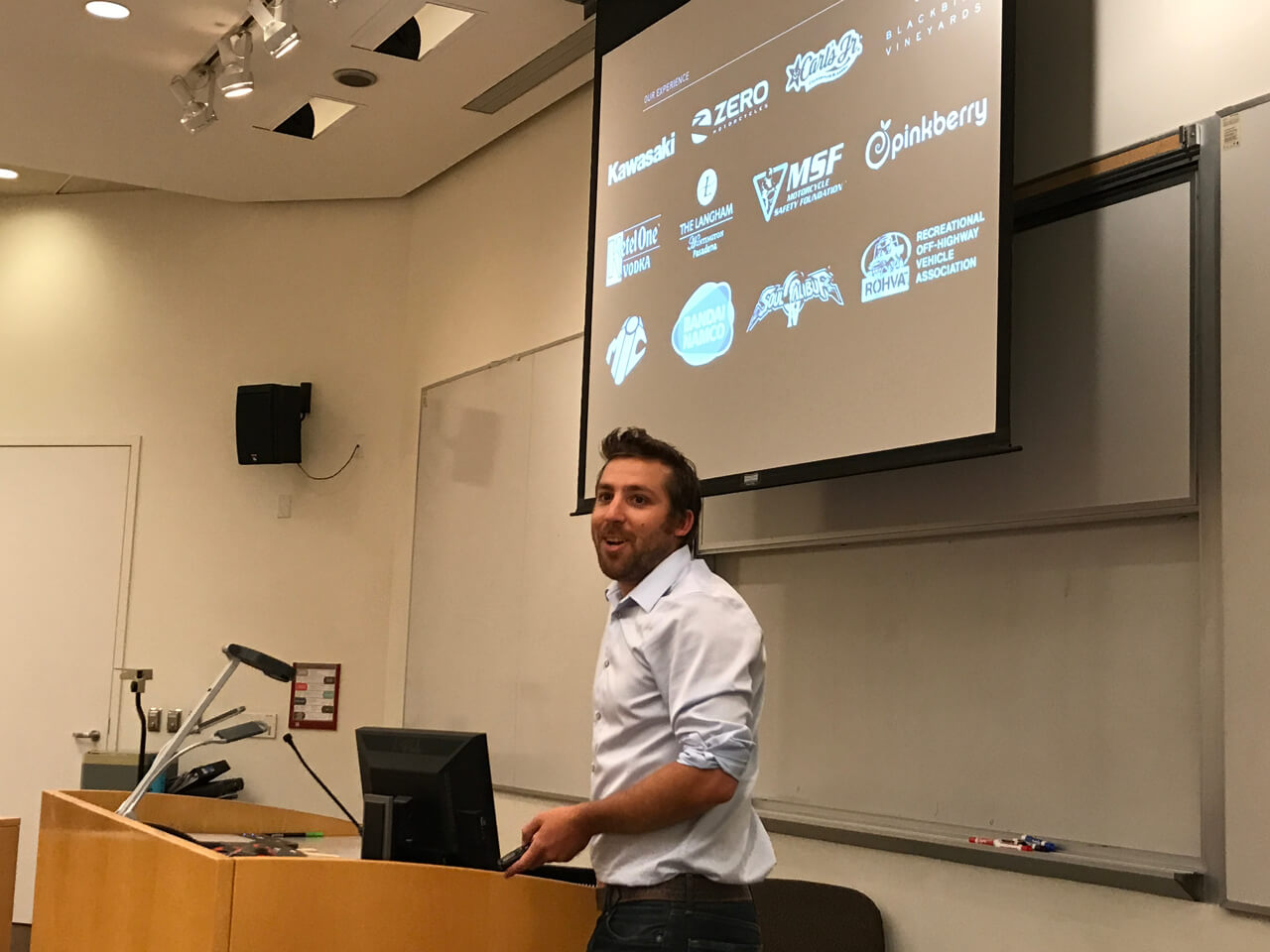
Had the honor of having two exciting guests in my International Marketing MBA class at Chapman University, Mr. Chris Brull, VP Marketing for Kawasaki Motors and Mr. Scott Shaffstall, CEO and Founder at Gen Now Agency as well as Chapman MBA Class of 2014 alumni. Scott has worked for Kawasaki Motors both in-house and as a contractor and we had a good interplay of ideas through the evening with my students.
As the theme of the day was international marketing communications, the discussion inevitably involved how you today need to use digital and social media channels to engage with prospective and existing customers. For example, when I asked Chris Brull about his take on customer journey mapping, I got the following intriguing response:
Chris Brull, Kawasaki Motors, Chapman University International Marketing MBA class
“Journey mapping is definitely important but it’s table stakes now, everyone should be doing it so you get it with the insights you gain along the way but in this business, with one brand and all the sub-brands we have, it’s spaghetti thrown all over! It’s not as linear as it was when you were watching 30 second spots, perhaps with some direct mail, you see a billboard, print magazine, and you go in and hang at a dealership.
The minute you think you’ve got the map set, it changes, cause you guys (looking at my students), your generation have blown up every piece of marketing technology and in fact today’s is already getting old. Why do you think Facebook is trying to reinvent, reinvent? Now the map goes everywhere cause everyone is insanely distracted, they’ve got their handheld, they’ve got their entire lives in their hand, so how are you going to connect? Is it a CRM program, an email program? I’ve gotta be on it 24/7, I’ve gotta be completely ready for every eventuality, it’s almost like Navy SEALs, when they go in, they are ready for everything! It’s insane!
But we’ve got to stay on it, I call it walking point, like in those war movies, they are out there in the jungle, it’s scary, you’ve gotta know where you’re going, sometimes you don’t, it’s dark, you get ambushed, you get shot, but you’ve gotta get back up, you need to be resilient. Sometimes I’d like to get in front even further but you don’t want to get too far ahead. Where are my marketing partners, my agencies? Sometimes those guys want to play it safe but cannot be left too far behind.
What it really boils down to is that you have to be present, you’ve gotta know your customer completely, then you have a chance at engaging them in the right way in the right channel at the right time.”
Scott Shaffstall on clients of his Gen Now Agency
Exciting times to be in marketing, right? Or is it getting almost too scary? Are you feeling agile like a Navy SEAL out there? At least, I am confident that the role of social media to engage with prospects and customers in various channels at different times is not going to go away anytime soon. While the customer journey may become ever-more unpredictable, I predict that social media will play an even more important role going forward both for helping detect the need for and for actually engaging with customers through real conversations.
In fact, I believe so strongly in that the brands that manage social media engagement right are going to find more opportunities to succeed even in an age of marketing automation. This could be their key differentiator. That is why I am writing a book titled The Social Customer Journey and I would be thrilled if you choose to learn more about it by filling out the form below, thank you!
Warming up for this week’s Social Media Marketing World 2017 conference while on skis at Mammoth Mountain. Click the video below to join the ride where I share some thoughts and expectations.
I apologize for the wind noise in the video, I need to cover the mic next time I do a skiing vlog! Anyway, some of the key points I discuss are outlined below.
Chapman University Continues Volunteering Tradition
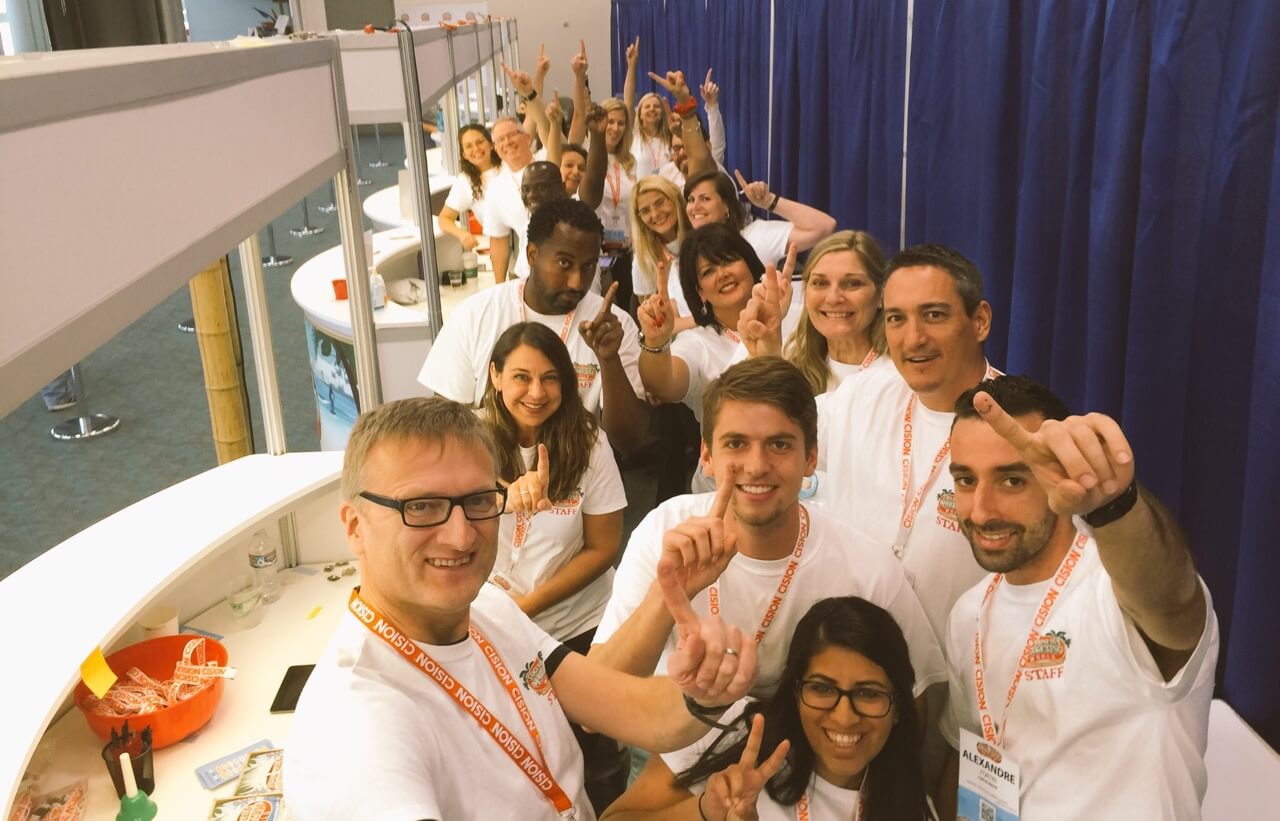
For the 3rd consecutive year, Chapman University is represented at Social Media Marketing World with volunteers helping run and deliver a world-class event. Please see earlier blog post about Chapman University volunteers at Social Media Marketing World 2015. Quite the community has grown around volunteering for this event and many come back year after year. I certainly am looking forward to seeing many of the friendly faces again! See pic here from the registration crew in 2016!
What would you like to learn?
If you would like me to pick up some insights around a particular topic that you are interested in, certain thought leaders you’d like me to interview, please let me know and I will try to pick up some valuable information for you. If you cannot make it to sunny San Diego yourself, you actually can buy the Virtual Pass for Social Media Marketing World which gives you access to all the sessions in recorded form to allow you to stay up to date. You can also make sure you are subscribed to my email newsletter which I plan to use to share some of the trends, tools, and tactics that I identify during the event.
Digital Marketing Strategies
As a “Digital Strategist,” I am keen to learn more about what the most effective strategies are within the realm of both social media marketing specifically, but also digital marketing strategies more broadly. How do you find the right balance between the use of smart tools with marketing automation and true social engagement in which you have to spend more of your time actually building and nurturing customer relationships? Also, what does it mean to be a digital executive today? To what extent does the company brand depend upon the CEO having a presence on social media? Moreover, how can you use marketing analytics to learn what works best for you, what activities you should engage in more and which ones to do less of? Those are some of the issues I will be trying to cover and again, if you are interested in what I learn, please ensure that you are subscribed to my updates further below or if you are really into it, I suggest you consider getting the Virtual Pass to Social Media Marketing World.
Much can be said about the pros and cons of working from home. Some think that working from home is better as they feel that they face too many distractions in an office environment so that they need to work from home to get things done, at least for demanding work that requires your full attention. Others find that surprising distractions can happen at home, too, just as Professor Robert E. Kelly learned while he offered his views on South Korea’s political turbulence after the prime minister was impeached.
Inspired by Dr. Kelly’s troubles keeping his kids out of the broadcast, I was interviewed by CBS LA’s Stacey Butler and they also made the rounds near Chapman by asking people on the streets around the Orange Circle in Old Town Orange if they had experiences with working from home. Please enjoy the clip below even if the quality is not great as I literally filmed the live streamed news segment on my desktop screen using my phone.
While I recognize that the impeachment of the prime minister was a historic and important event in South Korea, I could not resist laughing out loud when I saw how Professor Kelly’s young children stormed his home office. What was funny was the stark contrast between his happy children and his own attempts, only half-successful, at keeping a straight face.
Kids disturbing BBC News interview 2
Kudos to BBC News for making this 1-minute “blooper reel” clip available on their YouTube channel. I first saw this clip shared on my brother David Myhr‘s Facebook feed and, in turn, I shared it with my friends adding a comment that this showed the risks that you take while live streaming as just about anything can happen.
I will be on @BBCNewsMedia / @BBCWorld in 10 minutes to talk about the Korean impeachment.
A few hours later, another Facebook friend complained that her feed was over-saturated with this video and as I didn’t want to annoy people, I removed it thinking that it had served its purpose by then. However, five minutes later, CBS Los Angeles evening news called and wanted to interview me on camera and I had to rush to Chapman University as I ironically enough was “working from home.”
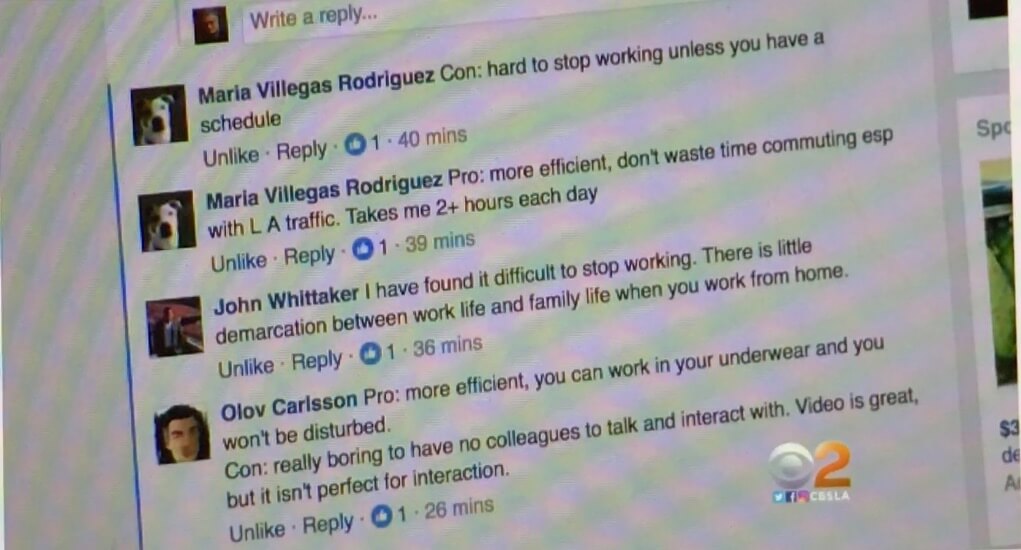
As I only had half an hour to prepare, I crowdsourced some ideas from my Facebook friends who quickly came to the rescue offering many interesting observations regarding the tradeoffs involved (thanks!). In favor of working at home was arguments such as the efficiency of being able to skip the long commute and the ability to focus, but the downside could be that it is hard to remember to stop working, the lack of social interaction with colleagues, plus the aforementioned risk of being disturbed by people at home.
In the interview, I tried to explain the viral nature of the video:
We are overburdened with information, we get too much of the serious stuff so sometimes we take note of things that are the abnormal.
Also, I stressed that workers at home don’t necessarily have to wear formal clothing but rather that the important thing was that the employee is feeling productive. I even said that with even more people working from home, it may become unprofessional to be too professional. Takeaway? Take yourself lightly, as Stacey Butler so eloquently put it in the conclusion of the story 🙂
There is something about live streaming or live video that a recording posted after the fact never can reproduce. Perhaps it has to do with the fact that unexpected events can occur that cannot be edited out. But I think that producing valuable live streamed content is about more than giving people watching the hope that they can see a train wreck happening once in a while however fascinating that might be. Indeed, in a business context, if used right, I strongly believe that live streaming represents a great opportunity for both marketing and sales.
While I have experimented some myself as a live streamer, I have also learned about what seems to resonate with people by being a lurker on other people’s live streams. I also very much enjoyed attending the recent Summit.Live LA to network with (see pics of terrific people below!) and listen to prominent live streamers and get a sense of what is going on in that growing community. In this post, I will outline some success factors for producing live stream content that your followers will appreciate and be likely to share with their followers.
Passion
Whatever personality you have, you have to work a little bit harder to truly show up and make you and your personality noticeable via live video. No, not everyone can be as passionate like a Gary Vaynerchuk but still. If you really focus, you actually can be a little bit “more you” than your “regular you” to allow for your personality to shine. Gary Vaynerchuk shows up in a passionate manner for every episode of his popular #AskGaryVee Show and while his show is posted on Facebook and on YouTube after the fact, it is also being live streamed via Periscope as it happens. That is, there are no second takes or much editing involved except for the preroll intro that the eminent “Team Gary” adds to the recorded version. See the following clip for the #AskGaryVee Show Episode #222 in which I was honored to be featured during my “reverse internship” for Vayner Media.
Presence
Part of the appeal with live streaming is the sensation you can feel by being present with someone else in the same, albeit virtual, room at the point of time. For example, an influential person running and hosting a live webinar has to take that same time off everything else exciting they may have going on in their lives and instead spend it with you. You become equals of sorts. At least for a small amount of time here or there. Someone who always shows up with a full focus on the guests and the live stream is my friend Mitch Jackson and his cohost Jen Hoverstad of excellent weekly show TheShow.live. When I had the pleasure of being interviewed there, Jen was having a great substitute host as well, Nick Rishwain and you can see this episode below:
Purpose
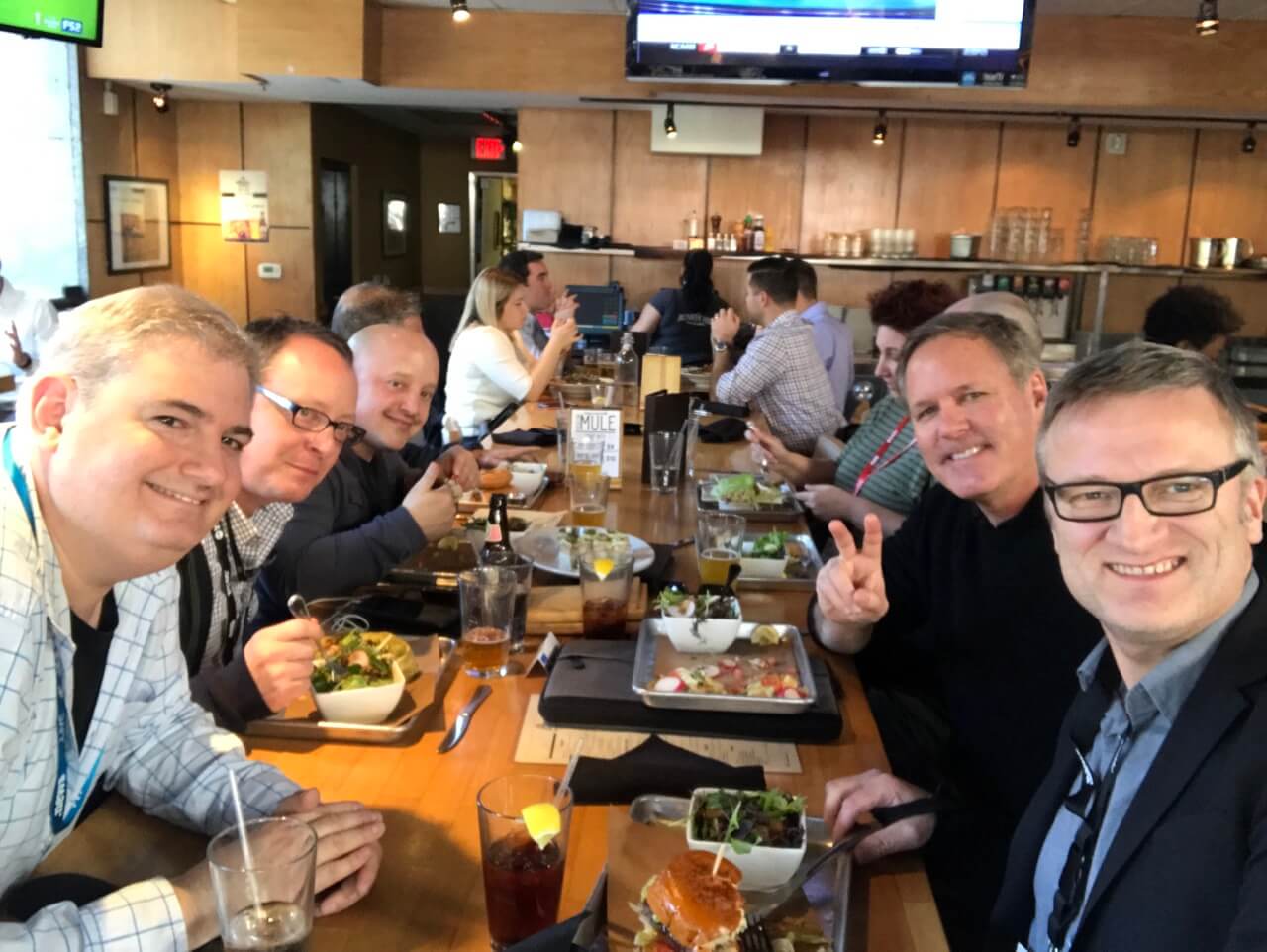
Summit Live Lunch
Try to have at least one key message in each broadcast that delivers something of value to your followers. Perhaps you can outline some key talking points about what you would like to share during a particular session? Having a purpose is also about caring about the connection you can make with viewers and perhaps your key purpose is simply to listen intently to their concerns and offer some emphatic response to show that you care. The key is that your purpose should be aligned with what your followers value and that you are generous with what you offer them whether it’ll be in the form of say educational, inspirational, or entertaining content.
Profit
Eventually, if you are considering doing live streaming as part of your business and not merely as a hobby, you need to consider how your live streaming activities fit into your overall business model. If you cannot connect live streaming to some revenue-generating outcomes, you likely will not persist. In this regard, live streaming can help generate revenue in two major ways. First, your live stream could be a way for first-time visitors to your world to get to know you in an expedited manner as they actually get to “meet” you at least online. Obviously, you need to find a way to bring your live stream to their attention either by advertising it or having your followers share it with their connections. Second, you could also live stream to strengthen customer satisfaction and loyalty amongst your existing customers which could make them buy again and perhaps buy more as well. What most seem to do in terms of live streams and monetization is to encourage their viewers to sign up for their email list so that they can deliver valuable content to them until they are ready to buy something from you. Most would be hesitant to buy and marketers nervous to try to sell on the first encounter.
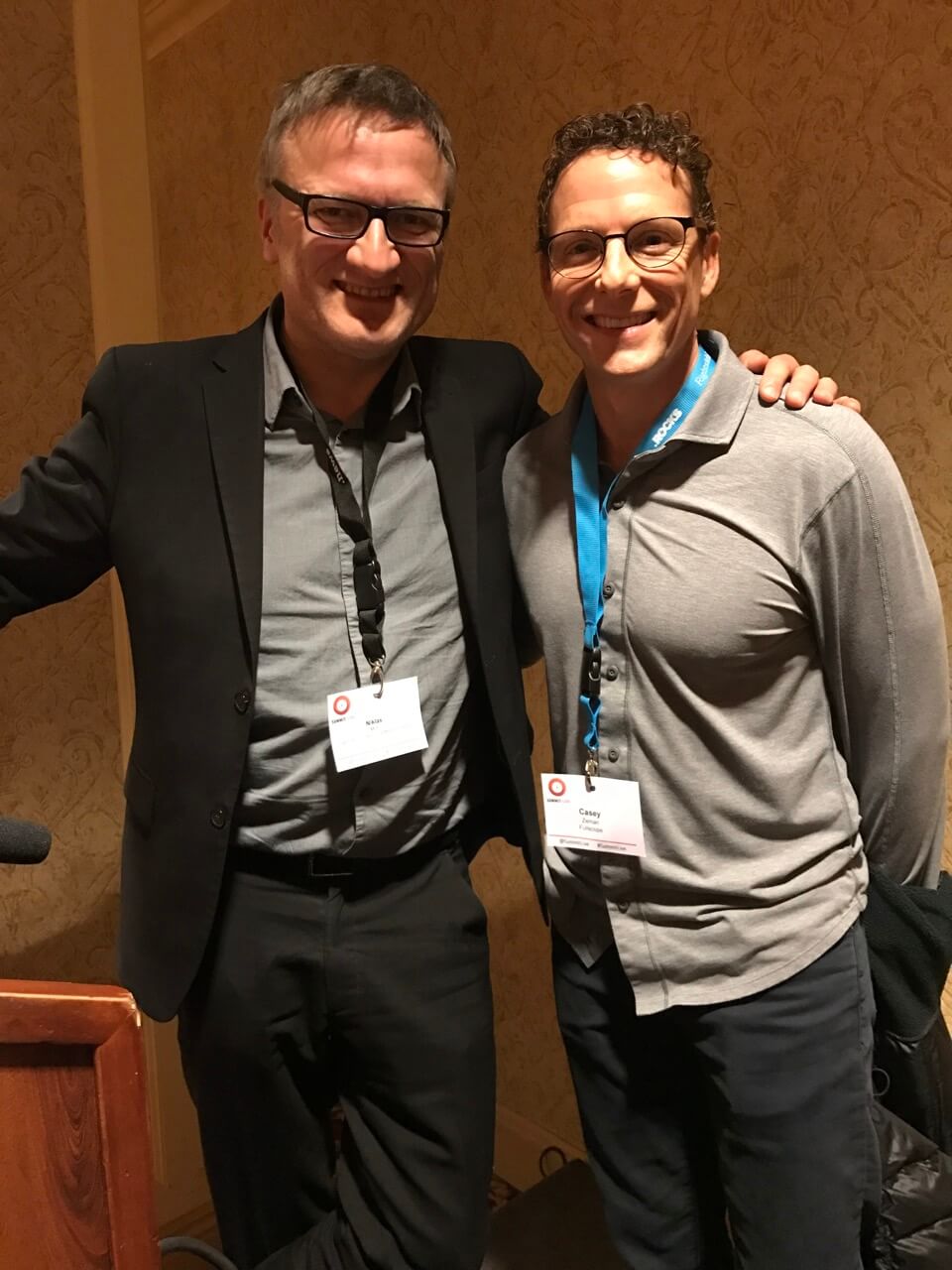
With Webinar and Live Streaming Pro Casey Zeman
Still, in some cases, the live stream encounter becomes so powerful that it even can result in immediate profitable outcomes even from first-time visitors during the broadcast such as via a live webinar. A webinar is typically is designed to deliver 60 minutes of valuable content which then turns into a pitch for something that you have to offer to those who are likely interested in you and your offerings if they are still on the line. Increasingly, live stream platforms are also embedding payment mechanisms in various formats to accommodate those who would like to be able to sell something during their live streams. For example, a “hot” platform at Summit.live was one of the sponsors, Busker [update: no longer in business]. Busker allows fans to either send hearts or tips to creatives that they enjoy such as musicians. YouTube live also allows for so-called Super Chat by which fans can pay say $5 to have their comment prominently displayed at the top of sometimes noisy comment fields.
Patience
I noticed the need to be patient myself as I ran a Facebook Live stream (see below) during a walk in LA between two sponsored evening meetups. It took a while to get just a few viewers but you also need to keep in mind that you can choose to post the video after the fact as well and once I did so, that video got a thousand views in short order. That is, don’t hang up just because you don’t have any viewers or perhaps only have a couple of viewers in the beginning of your broadcast. Some make the mistake of quitting too soon or launch into a planned monologue which gets lost in a virtual black hole. It may take some time before people find your broadcast and Facebook Live now sends a message to the broadcaster to hold tight while they are spreading the word about your live stream to build an audience. So what you can do is to welcome the few early birds and chat with them casually about where they are from, how their day is going and do some small talk just as you would if you greet early arrivals to your talk at a conference.
Planning
Panel with Nicole Abboud
To avoid the problem with empty virtual rooms, you would be well-advised to preschedule your broadcasts and make it an event that you promote via social media, email, etc. If you get people to add the meeting to their calendars, even better and you could also send them email reminders as the event gets closer. Some do a regular broadcast say weekly on the same day at the same time to also establish a routine so people may start getting used to looking out for you at that time even without a reminder or calendar appointment so that is maybe something that you would like to try.
Persistence
Whereas patience above was about being patient within a specific broadcast, here I use the word persistence to capture the essence of not expecting immediate results from just a few episodes of live videos. With a long-term, consistent output of quality live streams, you will gradually begin to grow your audience one person at a time. It is true that many will never become widely known or ever achieve virality in any major way. Still, you may begin to build a close-knit community of people who truly resonate with you and like Kevin Kelly wrote, you “only” need 1,000 true fans to have a career so go get it! Ok, while that number sounds more attainable than a mainstream breakthrough, it should be pointed out that Kevin Kelly argues that earning 1,000 true fans still is a matter of hard work and persistence but by being generous and persistent, you too can earn those followers over time! P.S. If you would like me to live stream more, perhaps via the Professor.live domain that I bought, please sign up below 🙂
Now having spent the weekend experimenting some with the Spectacles that my former student Jill so kindly lent me, I am offering some initial observations. First, they are good-looking in their own way. At least, they get people to laugh in a good way and the color is my cup of tea.
I also like the fact that they are not trying to have them blend in as regular eyewear. I remember how Google Glasses looked more like regular glasses and that when it was not obvious to the surroundings that someone would be able to video record them, they at times got very upset when they learned that this indeed was the case. The term “glassholes” was born. I should add that it may not be obvious to people that these Spectacles also can record video snippets but at least a signal is sent that something “weird” and out of the ordinary is going on.
Finally, the packaging is fun and provides for an engaging experience. Judge for yourself by looking at my Spectacles Unboxing video!
Congratulations to the founders of and the early investors in Snapchat or Snap Inc. on their successful initial public offering on the New York Stock Exchange today. Shares apparently rose 44% on day one and we can expect the luxury car dealerships around Venice Beach here in Southern California where the company is located to have some good weeks ahead of them.
I will not speculate about whether the stock price represents a fair evaluation or not. However, I can speak about my own experience as a user of Snapchat. In short, it has been a struggle. I have persisted over the last year to try to figure out the benefits and use cases of this platform as I enjoy keeping an open mind to new things. Still, I now find it difficult to even remember to check the app on a daily basis.
Snapchat User Interface
Immediately, I was struck by how unintuitive the user interface felt to me as I didn’t really recognize established patterns of how social networks were “supposed to” look look like. For example, fluent users swipe the screen up and down or right and left when I was used to click on menus and buttons.
Then I realized that this is exactly why they have appealed to a much younger demographic as they were not interested in yet another social network trying to mimic Facebook. For younger users, the user interface made perfect sense and then I realized that this app has been designed with a mobile-first perspective as opposed to a social network like Facebook that was designed for a desktop experience first only to be adapted to to a mobile interface at a later point. Looking back, I now remember how Facebook was both slow and not very apt at figuring out their transition to a mobile experience.
Reverse Mentoring
When my daughter Selma overheard me being interviewed over the phone by NBC News about social media trends last year, she said “dad, you are not allowed to talk about Snapchat anymore unless you learn how to use it!” Lo and behold, she sat me down and gave me a one-hour crash course to get started and this form of “reverse mentoring” is something I discussed in my TEDxUmeå talk. I think it is healthy to swallow your pride and accept the fact that young folks can teach you things just as you hope to share something of value with them at times.
This way, I was able to start experimenting some by starting follow people and share updates. I certainly had some good experiences and laughs along the way. I also noted that more people in my demographic, albeit heavily biased toward other marketing professionals, appeared on the platform and began using it for business and as a part of their “content marketing strategies.”
Add me on Snapchat 🙂
Snapchat Stories
My frustration over the fact that updates would disappear was alleviated when Selma taught me how to save my updates and even save a whole day’s worth of updates in so-called Snapchat Stories. I began obsessively saving everything I did thinking that I may want to repurpose that content later on other platforms or simply have them on my phone to be later exported to my trusted desktop experience.
Then Instagram “stole” the concept when they launched Instagram Stories. My daughter was quite upset about the unfairness of the whole situation. I tried to respect her frustration by not jumping over completely at least not right away. Still, I soon recognized that many more of my friends were on Instagram and the engagement I got from my Instagram Stories quickly dwarfed the response I saw on Snapchat. Hence, I began using Instagram more and Snapchat only sporadically.
My Future with or without Snapchat
My reduced usage of Snapchat may have less to do with the platform per se and more to do with the social network of people I have and where they hang out. Not so much on Snapchat or perhaps I have not looked carefully enough. I believe I will keep using it and recently, Selma and I achieved a new milestone with a 5-day streak of snapping each other. Who knows, perhaps, I will go all Gary Vaynerchuk on the platform one day and give it another chance but I have my doubts and don’t expect to take the platform too seriously for my personal use.
That doesn’t necessarily mean that I am dissing the future prospects of Snapchat even if I like many others see that they have a formidable foe in the Facebook/Instagram combo that doesn’t seem to have any qualms about adopting the best features Snapchat come out with. At least Selma, 13 years old, still spends (too much…) time using Snapchat and have streaks with her friends going on in the 200+ days range. However, she isn’t too impressed by the “Spectacles” sunglasses the company is pushing.
What about your experiences with Snapchat? Am I missing out? Will you be my snap buddy?
If you’d like to check out my TEDxUmeå TEDx talk in which I talk about my reverse mentorship experience with Selma and Snapchat, have a go at it and let me know what you think!
Are you publishing content every day? Are you posting something of value online every day? My estimate is that most would answer no to both of these questions. Still, I would submit that more of us are capable of publishing more regularly than we are today without necessarily sacrificing “quality” however that is defined.
When I studied Quality Engineering and Management at Linköping University in Sweden, Professor Bo Bergman instilled in us that quality is achieved when the product or service being produced is doing what it was designed to do. That is, high quality is not necessarily the same thing as something very significant or groundbreaking, it could at times merely be that a small widget came out the way it was supposed to.
Ultimately, the quality is in the eye of the consumer of whatever is being produced and if it fulfills a need for them, the job can be considered well done. In the case of content being produced for social media and websites, I think that there is room for both content nuggets and significant pieces of work. For example, some content could be in written form such as a short post on Facebook, and sometimes, it could be a longer blog post or thoughtful piece of text on Medium or LinkedIn. A video could be a 30-second thought that you share with your followers from your smartphone and at other times, you could publish a longer and more highly produced video.
Today, March 1, a prominent Swedish blogger Fredrik Wass is starting a challenge for the sixth consecutive year called #blogg100 to see if people can commit to and deliver on the objective of publishing some form of content daily for 100 consecutive days. One of the objectives is to stir up some life in dormant blogs and topics could be anything. The content does not have to be limited to blog posts but can be video or some other form of social media update as long as they are using the #blogg100 tag. Blog in Swedish is using two g’s for blogg in case you wonder… Anyway, are you up for the challenge (sign up form in Swedish in case you would like to confuse Fredrik with an international submission)? This is my first entry, 99 to go 🙂
So, Twitter CEO Jack Dorsey is considering allowing for tweets to be edited. Not only does he state that this is the most requested feature from users of Twitter but he also admits that he himself has wished numerous times that there was an option for him to go in and edit a recent tweet with minor updates for typos, etc.
This is our most requested feature (today & always). Mostly to quickly fix mistakes. Anything beyond would need to show revision history https://t.co/fHtGNjkuEx
I can see why such a feature would be welcomed by many and it would also mimic the capabilities of other platforms such as Facebook and Instagram which allow for edits of postings to be made. However, such a change would not come without complications and apparently Twitter is actively considering how necessary accommodations could be made. For example, should there be a backlog of revisions made as tweets now are considered public record. News organizations and others should be able to refer back to the specific version of the tweet that they considered while reacting to it. Also, should edits be allowed only for a few minutes after a tweet has been posted and what happens if numerous people retweets or embeds a post that then later is significantly edited?
While I agree that Twitter needs to be concerned with the viewpoints of their loyal user base and that they need to innovate as they move forward to also attract new users, my take on this proposal is that it is a bad idea. I don’t think people on the street not yet on Twitter are staying out because they cannot edit tweets. Also, I find it hard to label the workaround as onerous. People realizing they have posted a Tweet they regret can simply delete the tweet and then repost it as they see fit.
I recognize, though, that sometimes a tweet involves more than simply typing 140 characters as a tweet also could include videos or pictures with tagged people, etc. Still, Twitter could allow for such tweets to be reposted in a simpler way than before by allowing old tweets to be repurposed as a draft of a new one. Currently, underneath the option “Delete Tweet,” they could add another option, “Delete Tweet but add content to Compose new Tweet” or possibly “Delete Tweet, add to Drafts.”
.@jack Allow for mistweets incl pics, tags, etc, to be repurposed as drafts “Delete Tweet, add content to Compose New Tweet” #Twitter2017 — Niklas Myhr, Ph.D. (@NiklasMyhr) December 30, 2016
Regardless, kudos to Jack Dorsey for soliciting feedback on the platform and for demonstrating the power of conversations on Twitter with a truly responsive attitude in his very active presence on Twitter today so I have decided to remain on Twitter also in 2017, will I see you there?
Conversations: this is a big part of the magic of Twitter and currently really difficult to follow & manage. We’ll work to make this easier
Always happy to see examples of a symbiosis between my old world of Sweden and my new world of California. Such was the case when I had the honor of hosting a representative of the fascinating digital creative agency success factory North Kingdom in my Internet/Social Media Marketing class at Chapman University. During an enlightening presentation, Daniel Ilić, who heads up the US operation and serves as the Executive Creative Director and Partner of North Kingdom, shone a light on what makes up their culture and explained how it helps them produce world-class digital content and experiences for top brands such as Disney, Google, Beats by Dre, Netflix, Lucasfilm, UFC, Toyota, Volvo, LG Electronics, McDonald’s, and Lego. During Daniel’s presentation, some themes of the North Kingdom culture emerged and they were very consistent with the picture painted by Daniel’s predecessor in the US, Mr. Jakob Nylund, who helped prepare our Business in Scandinavia MBA travel group what a Scandinavian business culture is all about a couple of years ago.
A Frozen Land Breeds Remarkable Creativity
North Kingdom was founded in the city of Skellefteå in Västerbotten County up in northern Sweden. During the long, cold, and dark winters, not everyone could play for Skellefteå AIK, the team that has completely dominated Swedish elite hockey over the last decade. Nor could everyone achieve international pop success like legendary Skellefteå bands The Wannadies, This Perfect Day, or The Drowners (all contemporaries by the way of my brother David Myhr‘s band The Merrymakers). Left over were some childhood friends who bonded in the Skellefteå AIK youth soccer team before forming North Kingdom where they eventually found an outlet for their own form of creativity in helping international brands create unique digital experiences.
Just like my own hometown of Piteå in Norrbotten County an hour north, Skellefteå is part of what is now marketed as Swedish Lapland as creative entrepreneurs have turned ice cold winters from a liability to a treasure. You can achieve global awareness and attract international visitors with the icy offerings such as the ICEHOTEL, northern lights, dogsledding, igloo weekends, or with Japanese-style “Yukigassen” snowball fights. Even Facebook found that frozen is golden as they established its first major data center up in the city of Luleå partially thanks to the fact that the cold climate reduces the costs of cooling the data server halls. Now other international brands such as BMW Group has also found its way to “The Node Pole” at the Fortlax Data Center in Piteå founded by my friend Anders Berglund.
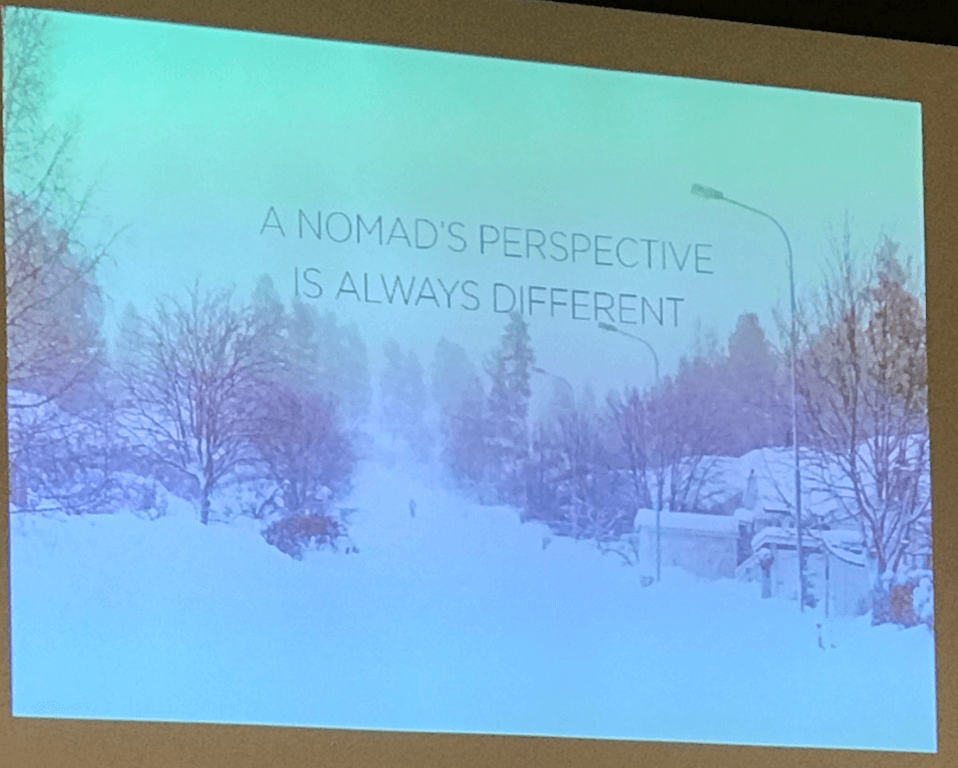
By still having the bulk of their operations based up in Skellefteå, North Kingdom, mainly serving international clients, always comes in as an outsider and thereby is in a better position to see things differently than people inside a bubble would. “A nomad’s perspective is always different” as Daniel expressed it.
Daniel Ilić also stressed that the winter darkness gives you creative opportunities simply because the mere thought that a small company up in arctic Sweden could compete and do business with global brands is so absurd that it spurs people up there in the cold darkness to come up with some really crazy ideas and to experiment with studid things that sometimes turn out to be quite remarkable. And that, remarkability, is exactly what is in short supply in an age when being different is a requirement to catch the attention of people in an ocean of sameness. “Safe is risky,” and bad or even bizarre ideas are what you need to get your ideas to spread as Seth Godin emphasized in a TED Talk.
Cultural Traits of Curiosity and Courage
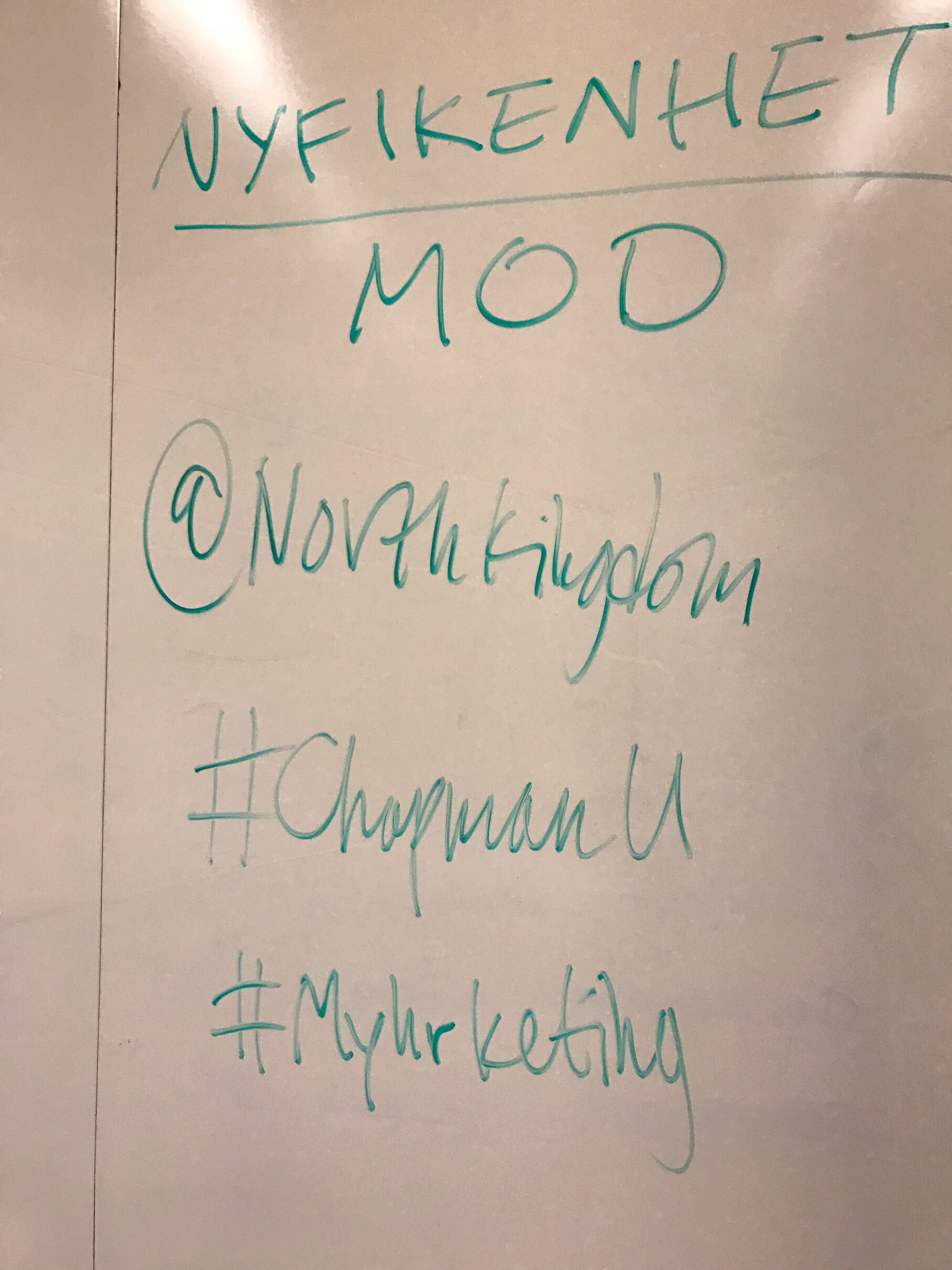
I specifically asked Daniel Ilić to share not only some digital communication insights and expertise but also to teach my students at least two words of Swedish. The two words he chose, “nyfikenhet” (curiosity) and “mod” (courage) turned out to perfectly capture the essence of the cultural traits that beyond the cold climate help explain why this small Swedish firm of North Kingdom has been able to acheive such astounding and award-winning success at the Cannes Lions Festival, etc.
Nobody gets hired by North Kingdom unless they can demonstrate an insatiable curiosity, i.e., they are motivated by their “nyfikenhet” constantly searching for new insights, inspiration, and knowledge and then people share what they have learned by teaching others. Teaching is highly valued and one of the founders, David Eriksson, is a former High School teacher.
Curiosity also helps North Kingdom learn from the customers with more intent by listening more carefully and trying to understand what their real issues are. Sometimes, this means speaking to the customers for hours on the phone mainly letting the client let off some steam about what is going on in their worlds.
When it comes to courage or “mod,” Daniel means that staff get emboldened by an extremely supportive team spirit that characterizes North Kingdom. People feel that they can stretch the envelope with out-of-the-box ideas as discussed above as they work collaboratively in teams getting instant feedback and where they constantly spur each other on. Gone are the days when creative agency work was done in siloed departments of single-area specialists and North Kingdom seems to have found the formula for team-based success.
Scandinavian Hours and Vacation
Finally, Daniel Ilić, explained how he worked hard to maintain a Swedish managerial style even as he heads up the US subsidiary. For example, if he finds someone working in the office at 6:30 pm, he kicks them out asking them what they are still doing there, that they should be going home and that he should join them on the way out! Similarly, the Swedish minimum vacations of five or six weeks are also “enforced” 🙂 In the end, healthy and happy employees are better and more creative employees. Which reminds me, I should go to bed now, so good night!
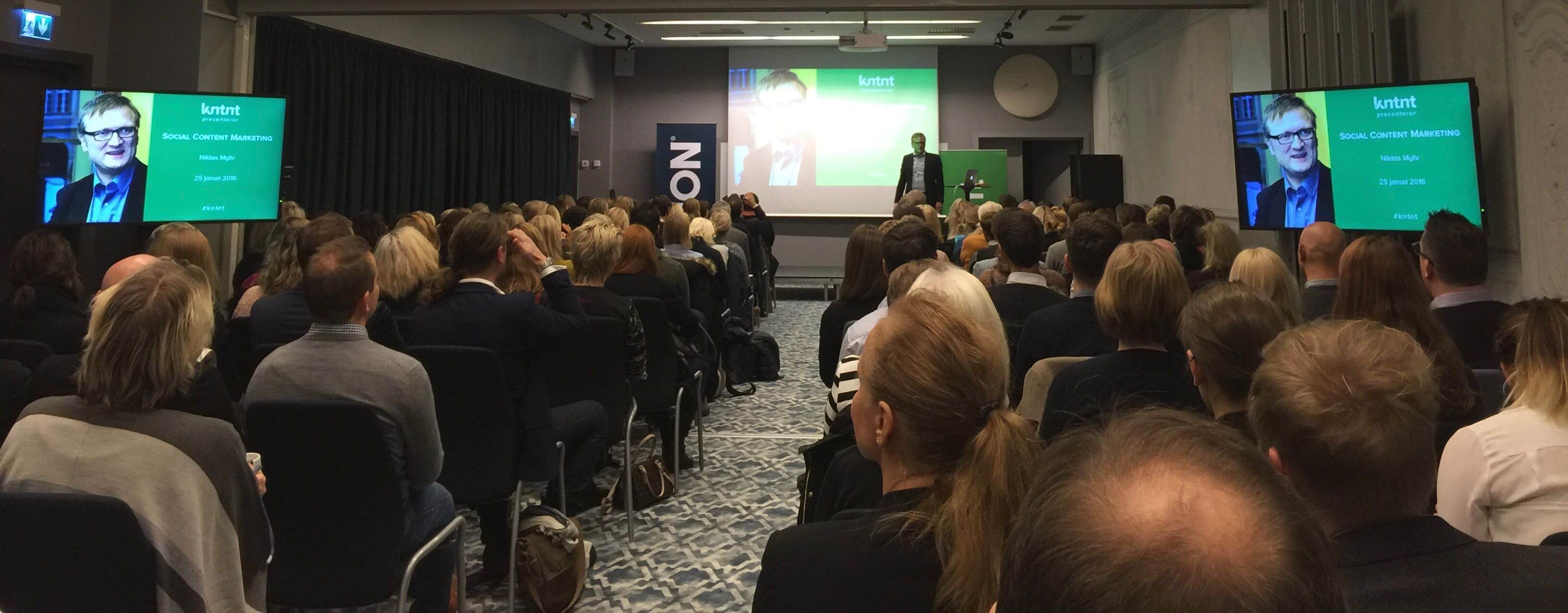
Niklas Myhr keynote on Social Content Marketing at KNTNTView from stage
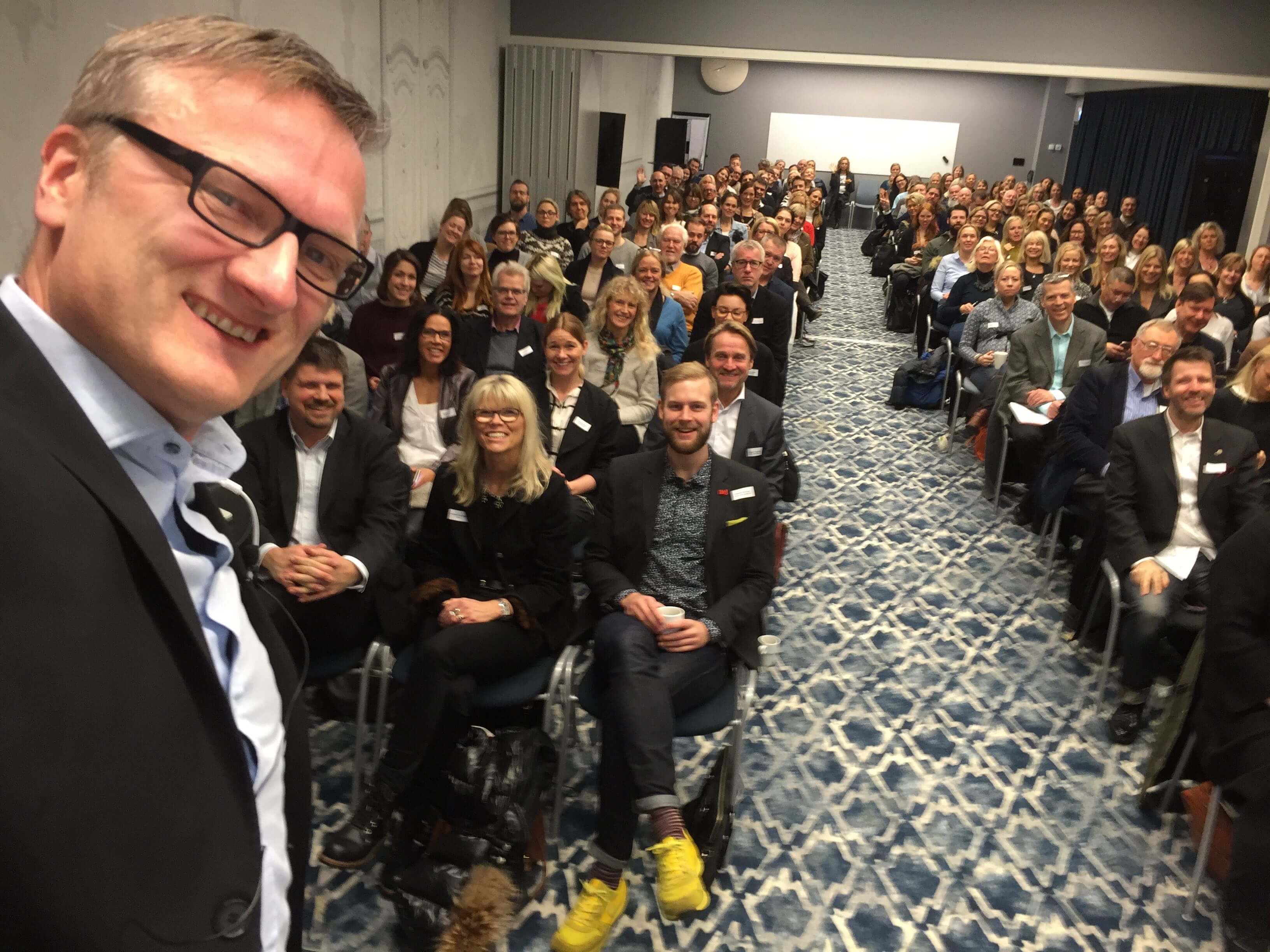
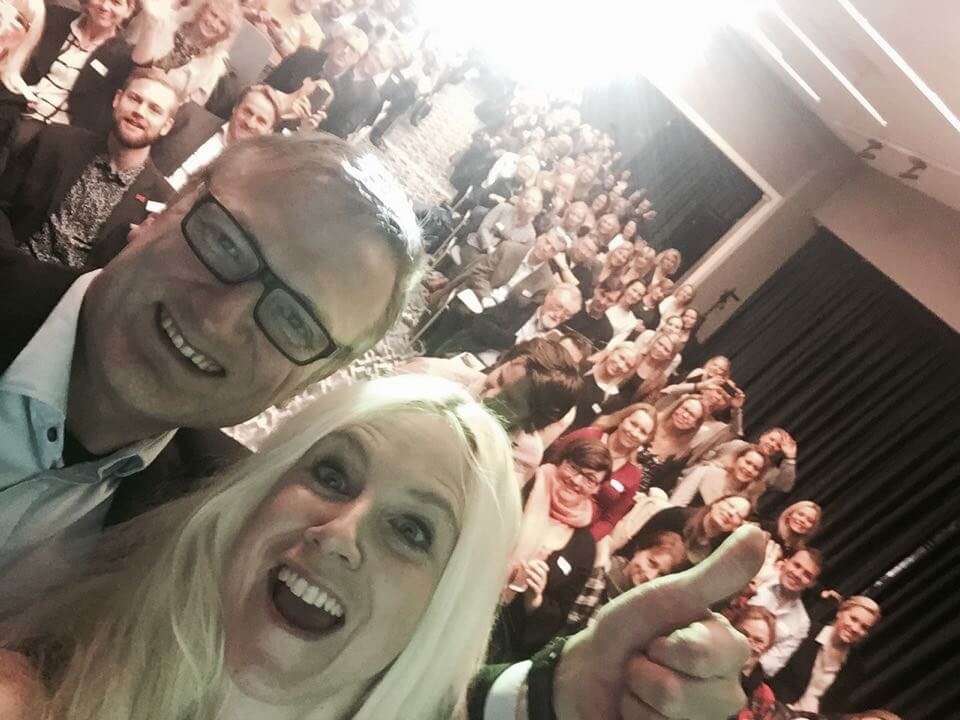
Enjoyed quite the whirlwind day yesterday when I paid a visit to Gothenburg on Sweden’s “left coast” and had a busy program together with my good friends and hospitable local hosts Pia and Thomas of KNTNT. Under the heading Social Content Marketing, I spoke to a full house of 180 attendees for a breakfast talk and then taught a full-day Content Marketing Master Class to a high-caliber group of marketing communications managers, consultants, and executives.
Niklas Myhr and Frida Boisen at KNTNT
Digital Success Principles with Frida Boisen
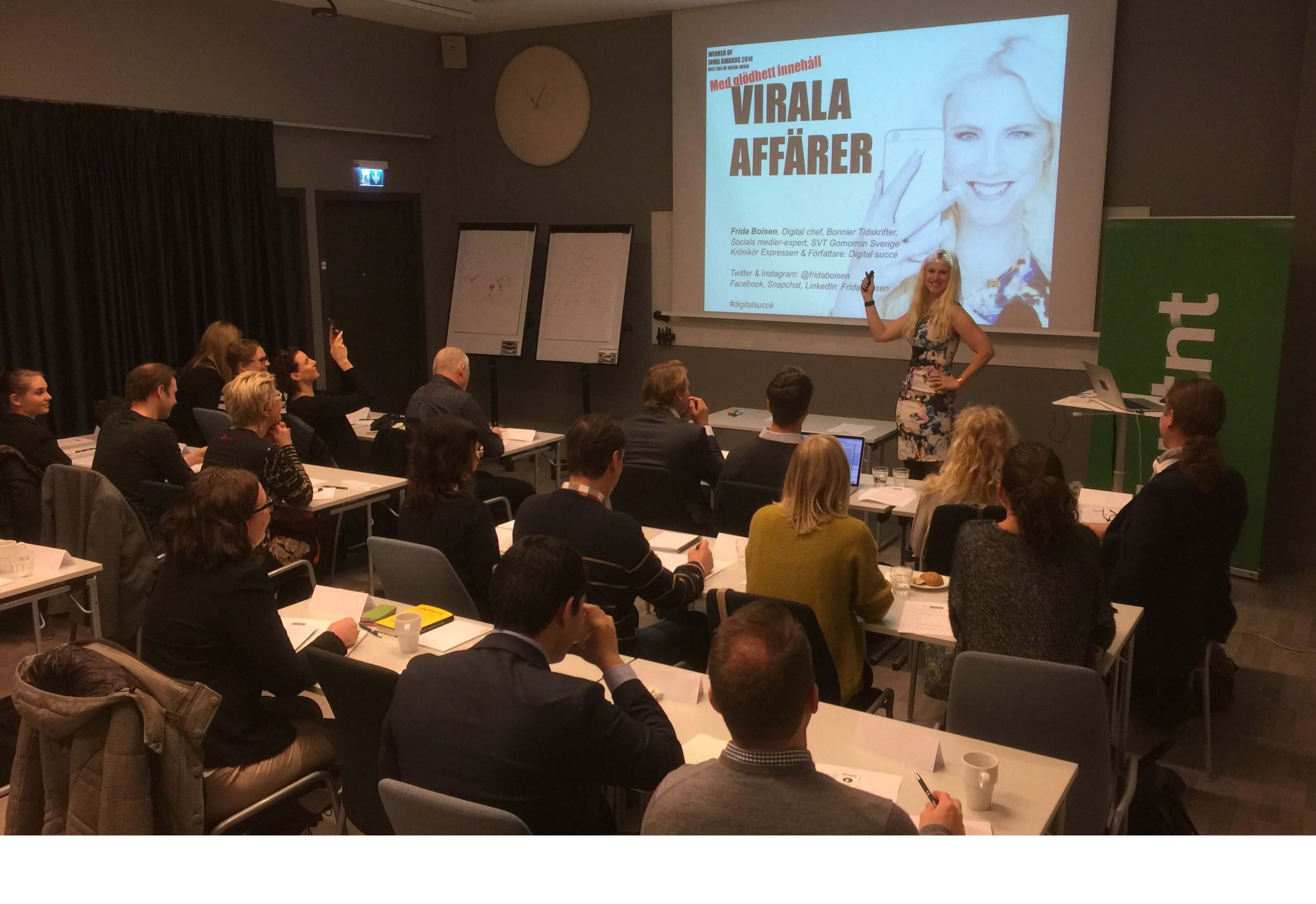
I was also very pleased that we were able to bring in two intriguing guest appearances. Leading Swedish social media expert Frida Boisen shared perspectives on how content can catch fire on social media and she particularly stressed the importance of bringing in the emotional element of communication for people to care. This and more can be found in her best-selling book Digital Succé, check it out 🙂
Content Marketing Success with Mark W Schaefer
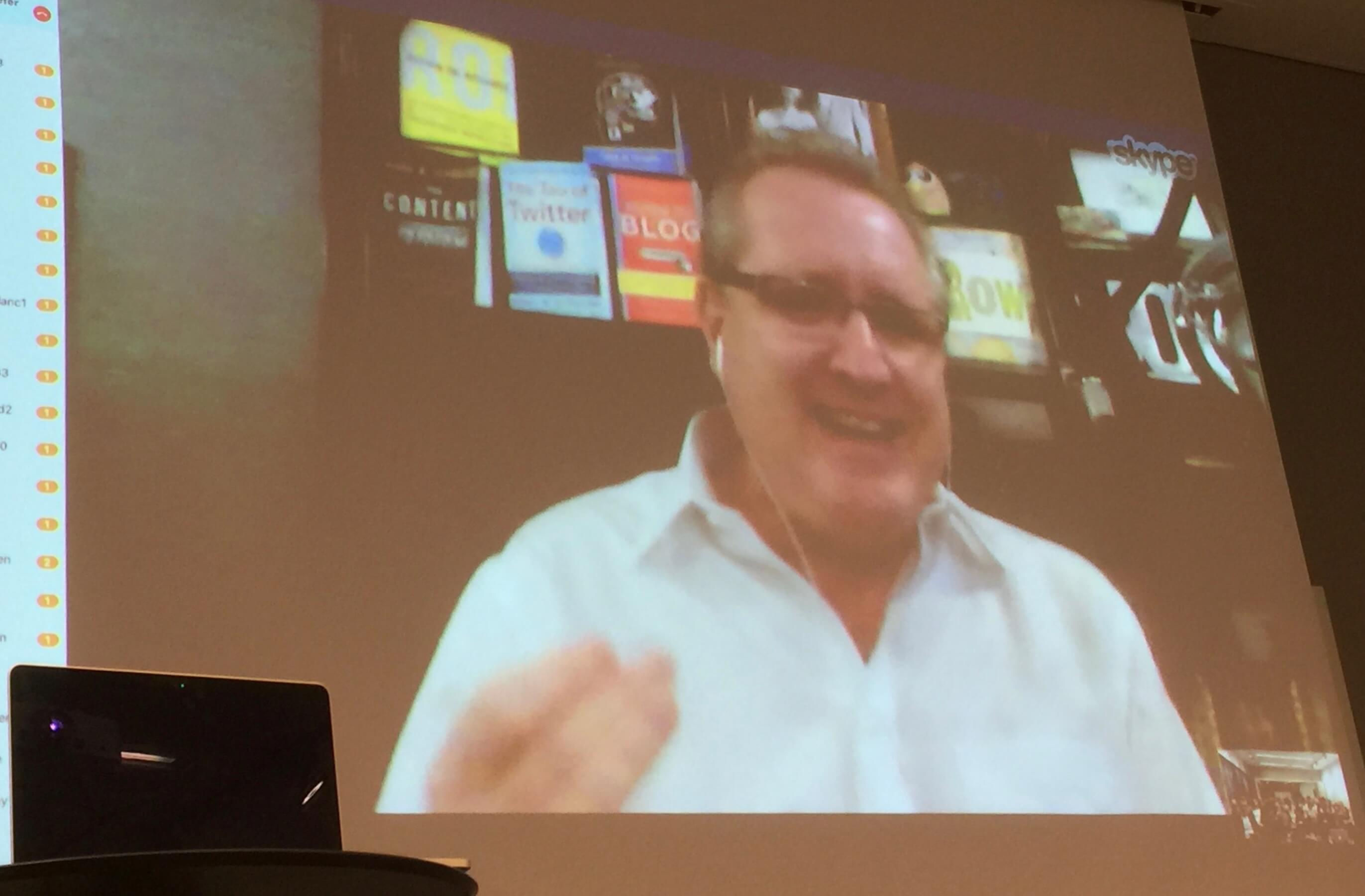
Mark Schaefer guest in Content Marketing Master Class
In the afternoon Swedish time, international content marketing thought leader Mark W. Schaefer joined us for a virtual session from Knoxville, Tennessee, during which he shared the thesis he presents in his groundbreaking book The Content Code. He stressed the importance of nurturing your so-called Alpha Audience, the relatively few followers you have who are regularly sharing your content. In fact, Mark Schaefer suggests that may be doomed if you do not start worrying more about taking good care of these ambassadors as their trust and ambassadorship may be the most valuable asset you have as competition for attention will only get worse. He cited an estimate that by year 2020, the amount of content will go up another five times from today’s already crowded web.
Social Media Marketing vs. Content Marketing
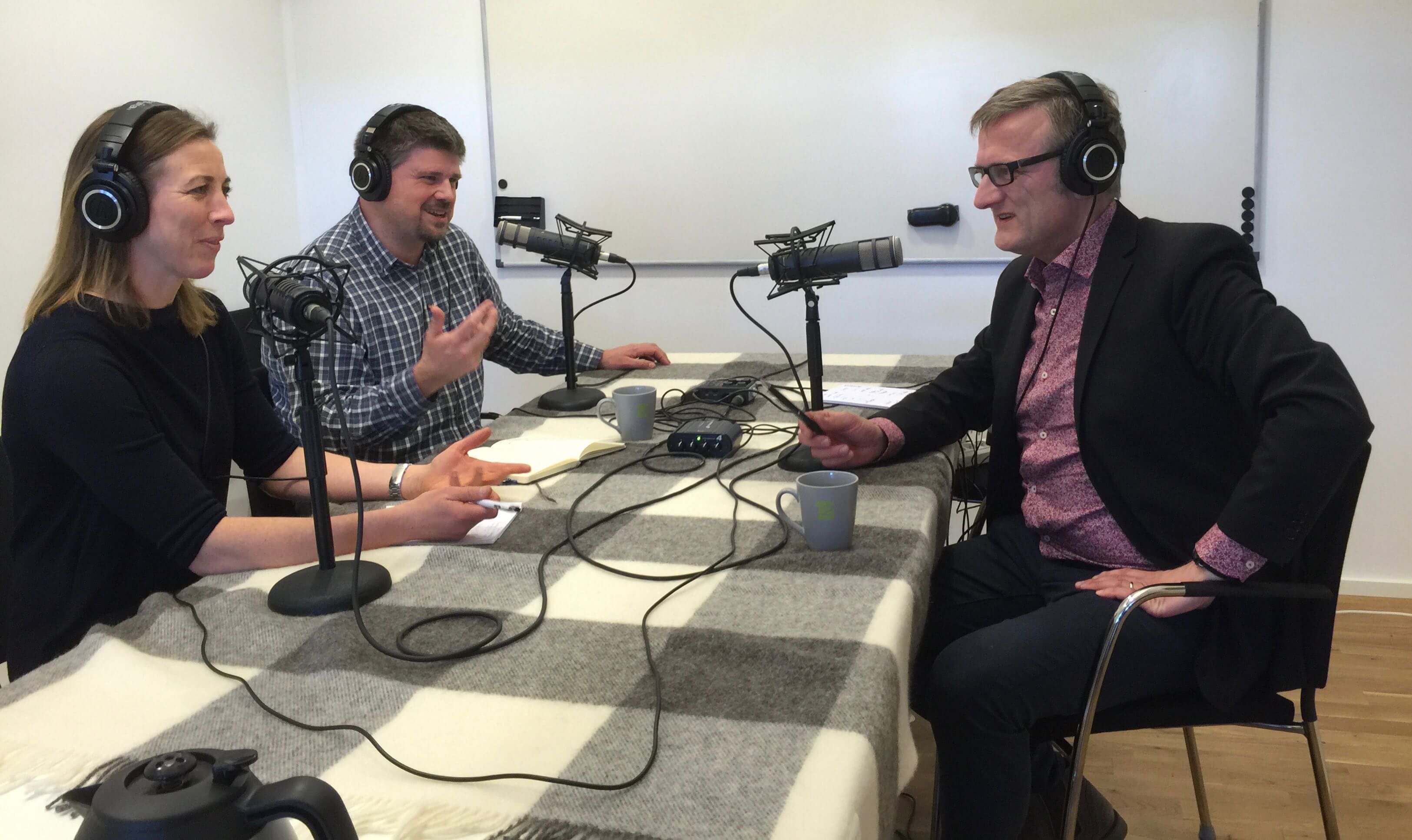
KNTNT Radio podcast interview by Thomas Barregren and Pia Tegborg
It is not surprising that it is challenging to discuss the interrelationship between social media marketing and content marketing as both terms are relatively undefined and are also undergoing changes in terms of how they are understood over time. That being said, social media marketing encompasses communications across a wide variety of social networks and stresses the interactive nature of communications amongst a group of people whereas content marketing takes as its point of departure a piece of content that should fulfill a number of criteria such as adding value and driving profitable customer action, albeit indirectly. This is the definition of content marketing that I used in my presentation:
“Content marketing is the strategic marketing approach of creating and distributing valuable, relevant and consistent content to attract and acquire a clearly defined audience – with the objective of driving profitable customer action.”
– Joe Pulizzi, Content Marketing Institute
Content Marketers becoming Professors
One aspect of content marketing that many struggle with is the extent to which they can talk about their own products and solutions in their content. While I am not going so far as saying that you are not allowed to mention your own product in your content marketing, the most effective content marketers seem to stay away from it to the largest extent possible. As a marketing professor, I have noted how content marketers are communicating and behaving more and more as professors these days as they are adding value to prospective and existing customers by teaching them ways to solve their problems irrespective of specific product purchases. It is best illustrated by the quote by Jon Ferrara of Nimble when he said:
If you teach people to fish, they’ll figure out you sell fishing poles.
– Jon Ferrara
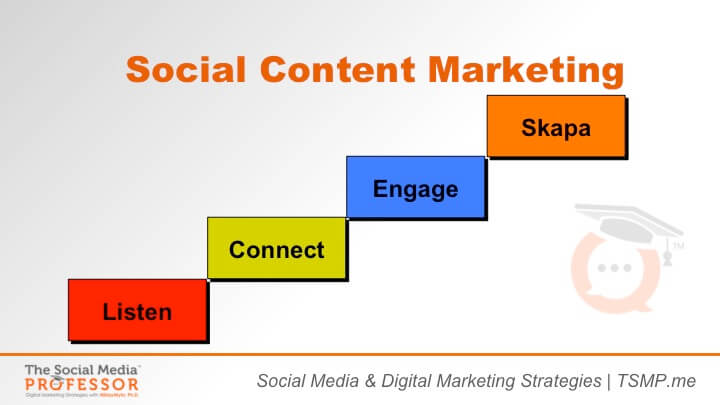
During the day, I covered four areas in which social media marketing and content marketing are interdependent and discussed how each can benefit from the other:
Social Content Marketing
Listening on Social Media for Content Marketing Ideas. What are the questions they ask on social media? On what platforms do they search for information? What are their frustrations?
Connecting to an audience suitable to your business using relevant content. By offering content that is particularly valuable to your target market, you can both attract the right type of audience to connect with you and identify themselves such as giving you their email address at the same time as you may even repel the wrong type of audience that sees little interest in the content that you offer.
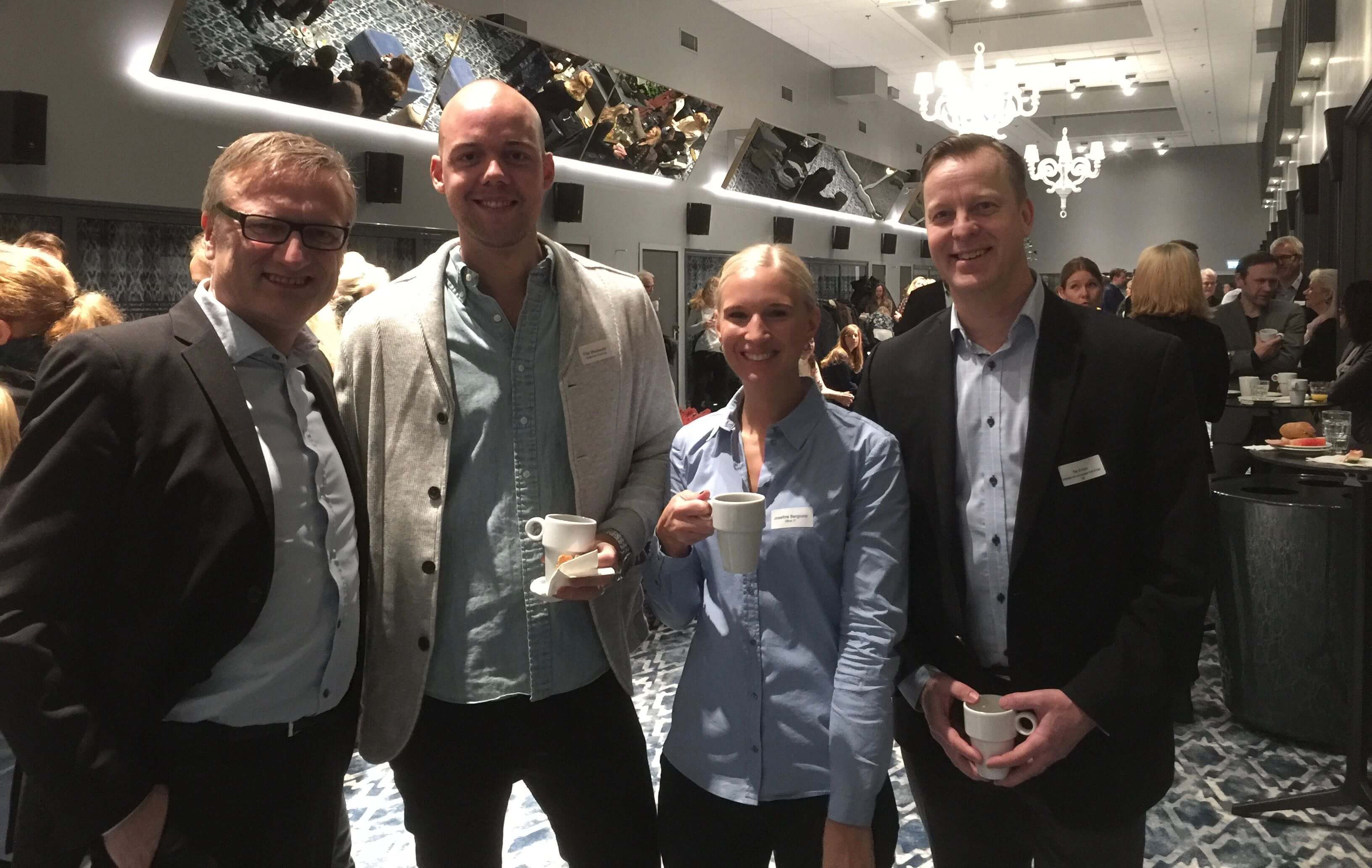
With recent Chapman University grad Filip Westlander, his girlfriend Josefine Berglund, and my cousin Per Ericson
Engaging. How can you get your followers to not only consume but also share your content on their social media platforms?
Creating. How can you motivate your followers to contribute their content for you to use on your platforms?
So, have you wondered about the relationship between social media marketing and content marketing? I am curious to learn about your thoughts and experiences so please let me know in the comments below!
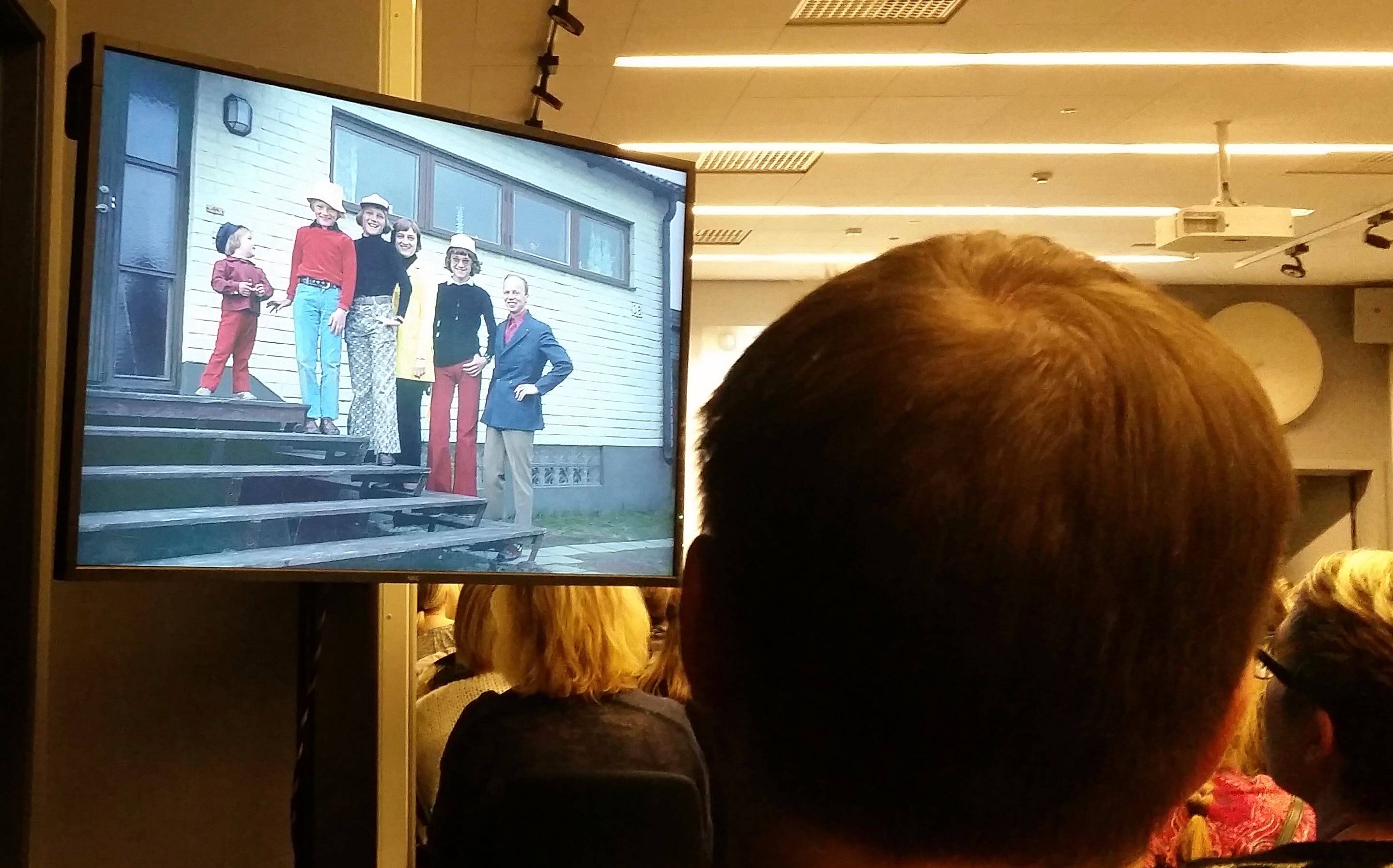
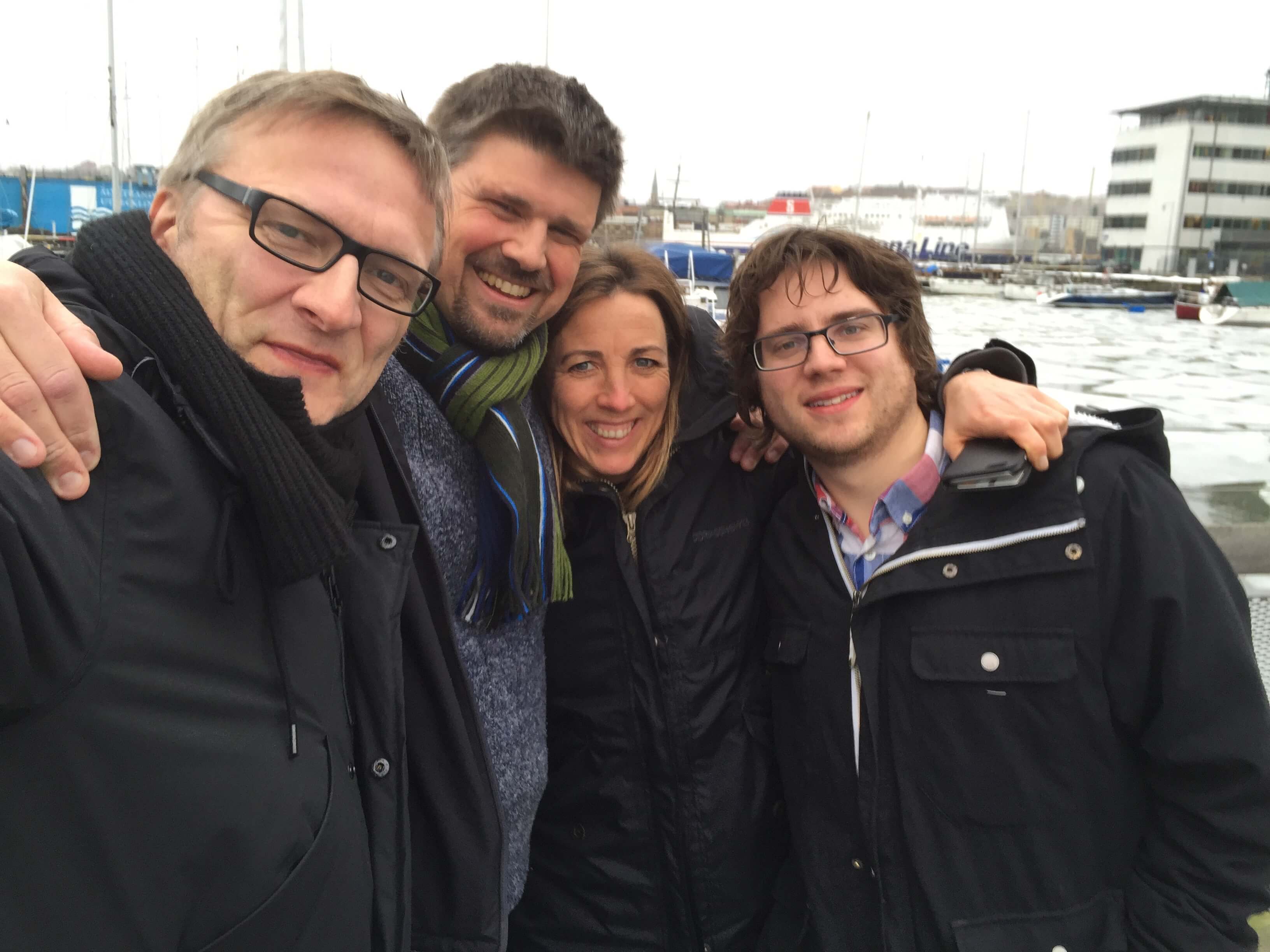
Frida Boisen’s guest lecture during my Content Marketing Master ClassThe Myhr Family back in the Piteå days (me with blue pants)Thanks to the KNTNT team of Thomas Barregren, Pia Tegborg, and Fabian Sörqvist